Blue mussel: Difference between revisions
CSV import |
CSV import |
||
| Line 32: | Line 32: | ||
{{Mollusc-stub}} | {{Mollusc-stub}} | ||
{{food-stub}} | {{food-stub}} | ||
<gallery> | |||
File:Miesmuscheln-2.jpg|Blue mussel | |||
File:Orientation_terminology_for_Mytilus_edulis.webp|Orientation terminology for Mytilus edulis | |||
File:General_anatomy_of_Mytilus_edulis_tissues.webp|General anatomy of Mytilus edulis tissues | |||
File:Internal_anatomy_of_Mytilus_edulis.webp|Internal anatomy of Mytilus edulis | |||
File:Mytilus_edulis_001.jpg|Mytilus edulis | |||
File:Mytilus_edulis_002.jpg|Mytilus edulis | |||
File:Mytilus_edulis_var._flavida_01.jpg|Mytilus edulis var. flavida | |||
File:Mytilus_edulis_var._flavida_02.jpg|Mytilus edulis var. flavida | |||
File:Mussel_bed.jpg|Mussel bed | |||
File:Normandy_'10-_Saint-Vaast-la-Hougue_(4826863803).jpg|Blue mussel | |||
File:Blue_mussel_total_production_thousand_tonnes_1950-2022.svg|Blue mussel total production thousand tonnes 1950-2022 | |||
File:Blue_mussel_Mytilus_edulis.jpg|Blue mussel Mytilus edulis | |||
File:Mussels-on-beach-20030601.jpg|Mussels on beach | |||
</gallery> | |||
Latest revision as of 21:22, 20 February 2025
Blue Mussel (Mytilus edulis) is a species of medium-sized, edible bivalve mollusk found in the northern Atlantic Ocean. They are known for their distinctive blue or black shells and are a popular seafood in many cultures.
Description[edit]
Blue mussels have a smooth, triangular shell that is typically blue or black, but can occasionally be brown or purple. The inside of the shell is shiny and pearl-like. Adult mussels can reach up to 10 cm in length, but are typically between 5 and 7 cm.
Habitat and Distribution[edit]
Blue mussels are native to the northern Atlantic Ocean, with a range extending from the eastern coast of North America to the western coast of Europe, including the British Isles and the North Sea. They are typically found in intertidal zones on hard substrates, such as rocks, but can also be found on man-made structures like piers and buoys.
Diet and Predation[edit]
Blue mussels are filter feeders, consuming plankton and other microscopic sea organisms. They are preyed upon by a variety of species, including sea stars, crabs, and birds.
Reproduction[edit]
Blue mussels are dioecious, meaning individuals are either male or female. They reproduce by releasing eggs and sperm into the water, where fertilization occurs. The resulting larvae are planktonic and are carried by ocean currents until they find a suitable substrate to attach to and grow.
Economic Importance[edit]
Blue mussels are commercially harvested and are a popular seafood in many cultures. They are often cooked in wine or garlic butter and served with bread or fries.
Conservation[edit]
While blue mussels are not currently considered threatened, they are vulnerable to pollution, habitat loss, and climate change. Efforts are being made to monitor populations and protect their habitats.
See Also[edit]

-
 Blue mussel
 -
 Orientation terminology for Mytilus edulis
 -
 General anatomy of Mytilus edulis tissues
 -
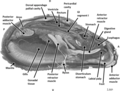 Internal anatomy of Mytilus edulis
 -
Mytilus edulis
-
Mytilus edulis
-
Mytilus edulis var. flavida
-
Mytilus edulis var. flavida
-
Mussel bed
-
Blue mussel
-
Blue mussel total production thousand tonnes 1950-2022
-
Blue mussel Mytilus edulis
-
Mussels on beach


.jpg)


