The Jungle: Difference between revisions
CSV import Tags: mobile edit mobile web edit |
CSV import |
||
| Line 18: | Line 18: | ||
[[Category:Social criticism]] | [[Category:Social criticism]] | ||
{{Literature-stub}} | {{Literature-stub}} | ||
<gallery> | |||
File:The_Jungle_(1906)_cover.jpg|The Jungle (1906) cover | |||
File:Beef_industry_panorama_1900_loc.jpg|Beef industry panorama 1900 | |||
File:Chicago_stockyards_cattle_pens_men_1909.jpg|Chicago stockyards cattle pens men 1909 | |||
File:Floorers_removing_the_hides_USY_Chicago_(front).tiff|Floorers removing the hides USY Chicago | |||
File:Chicago_meat_inspection_swift_co_1906.jpg|Chicago meat inspection Swift Co 1906 | |||
</gallery> | |||
Latest revision as of 21:22, 20 February 2025
The Jungle is a novel written by Upton Sinclair, first published in 1906. It explores the harsh conditions and exploited lives of immigrants in the United States in Chicago and similar industrialized cities. The novel is a significant piece of literature that brought to light the appalling working conditions in the meatpacking industry at the turn of the 20th century. Sinclair used this novel as a way to showcase his socialist views and advocate for improved labor conditions.
Plot Summary[edit]
The story centers around Jurgis Rudkus, a Lithuanian immigrant, and his family as they try to survive in the corrupt, harsh world of the Chicago stockyards. The family is confronted with numerous obstacles including workplace accidents, poverty, crime, and corruption. Despite their hard work and determination, they are continuously exploited by a system designed to benefit the wealthy elite at the expense of the working class.
Themes[edit]
The Jungle delves into several themes, including the American Dream, the conditions of the working class, and the effects of capitalism on society. Sinclair vividly illustrates how the American Dream turns into a nightmare for Jurgis and his family, highlighting the gap between the rich and the poor. The novel also exposes the dehumanizing conditions of the workers in the meatpacking industry, raising questions about ethics, morality, and the need for reform.
Impact[edit]
Upon its release, The Jungle caused a public outcry that led to reforms in the meatpacking industry, including the passage of the Pure Food and Drug Act and the Meat Inspection Act in 1906. Although Sinclair intended to focus on the plight of the workers, the public was more horrified by his descriptions of unsanitary food production that directly affected consumers. This unintended consequence nonetheless resulted in significant changes in food safety regulations in the United States.
Legacy[edit]
The Jungle remains a powerful work of social criticism. It is studied in high schools and universities across the world for its historical significance and its contribution to American literature and social reform. The novel has also influenced many subsequent works and continues to be relevant in discussions about workers' rights, food safety, and the impact of capitalism on society.

This article is a literature-related stub. You can help WikiMD by expanding it!
-
 The Jungle (1906) cover
 -
 Beef industry panorama 1900
 -
 Chicago stockyards cattle pens men 1909
 -
 Floorers removing the hides USY Chicago
 -
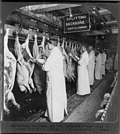 Chicago meat inspection Swift Co 1906
_cover.jpg)


