Migas: Difference between revisions
CSV import |
CSV import |
||
| Line 44: | Line 44: | ||
* [http://www.saveur.com/article/Recipes/Mexico-Migas Recipe for Migas] on Saveur | * [http://www.saveur.com/article/Recipes/Mexico-Migas Recipe for Migas] on Saveur | ||
{{dictionary-stub1}} | {{dictionary-stub1}} | ||
<gallery> | |||
File:Migas con Naranja (7068663227).jpg|Migas with Orange | |||
File:Migas.jpg|Migas | |||
</gallery> | |||
Latest revision as of 01:41, 20 February 2025
Migas[edit]
Migas is a traditional dish originating from Spain and Portugal. The term "migas" translates to "crumbs" in English, which is a fitting description for this dish that typically includes leftover bread or tortillas.
Origins[edit]
Migas has roots in the Iberian Peninsula, specifically in Spain and Portugal. It was traditionally a breakfast dish consumed by shepherds and farmers, who appreciated its simplicity and the fact that it could be made using readily available ingredients.
Ingredients[edit]
The primary ingredient in migas is bread, although in some regions, especially in the Americas, tortillas are used instead. Other common ingredients include garlic, olive oil, and paprika. Depending on the region, migas may also include meats such as chorizo or bacon, and vegetables such as peppers or tomatoes.
Preparation[edit]
To prepare migas, the bread or tortillas are first torn into small pieces or crumbs. These are then sautéed in olive oil along with garlic and other ingredients. The dish is typically served hot, often with eggs or meats.
Variations[edit]
There are many regional variations of migas. In Spain, migas can be found in the cuisines of Andalusia, Aragon, Castilla-La Mancha, and Extremadura. Each region has its own unique take on the dish, with variations in ingredients and preparation methods.
In the Americas, migas is a popular dish in Mexican cuisine, as well as in the cuisines of the southwestern United States. The American version of migas often includes tortillas instead of bread, and may also include ingredients such as cheese, jalapenos, and avocado.
Cultural Significance[edit]
Migas holds a significant place in the culinary traditions of the regions where it is consumed. It is often associated with comfort food and is a popular choice for breakfast or brunch. In Spain, migas is also often served during festive occasions and is considered a symbol of hospitality.
See Also[edit]
References[edit]
- The Food of Spain by Claudia Roden
- The Cuisines of Mexico by Diana Kennedy
- The Border Cookbook by Cheryl Alters Jamison and Bill Jamison
External Links[edit]
- Recipe for Migas on Food Network
- Recipe for Migas on BBC Food
- Recipe for Migas on Saveur

-
 Migas with Orange
 -
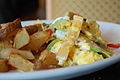 Migas
Migas
.jpg)

