Sausage: Difference between revisions
No edit summary |
CSV import |
||
| Line 94: | Line 94: | ||
[[Category:Polish cuisine]] | [[Category:Polish cuisine]] | ||
[[Category:Spanish cuisine]] | [[Category:Spanish cuisine]] | ||
<gallery> | |||
File:Wurstplatte.jpg|Sausage | |||
File:Sausage making-H-1.jpg|Sausage | |||
File:Grinners breakfast.jpg|Sausage | |||
File:Monroe Sausage.jpg|Sausage | |||
File:Salsiccia-fresca.webp|Sausage | |||
File:Russian Sausage Making.jpg|Sausage | |||
File:Smoked Chinese sausage.jpg|Sausage | |||
File:Lao Sai Oua.jpg|Sausage | |||
File:09794jfFajardo Echague Street Loyola Sampaloc Quiapo Manilafvf 16.jpg|Sausage | |||
File:Sai krok isan.jpg|Sausage | |||
File:Giò lụa.jpg|Sausage | |||
File:Sausages Oxford.jpg|Sausage | |||
</gallery> | |||
Revision as of 01:35, 20 February 2025
| Sausage | |
|---|---|
| Name | Sausage |
| USDA_ID | 10153180016 |
| Food_group | Fish‚ Meat‚ Eggs,Processed meat |
| Keto_friendliness | Medium carb |
| Calories | 253 |
| Fat | 17.33 |
| Protein | 10.67 |
| Fiber | 1.3 |
| Net carbohydrates | 10.7 |
| Sugars | 0 |
| Cholesterol | 0.04 |
| Saturated fats | 5.33 |
| Serving description | Sausage |
Introduction

Sausage is a type of meat product that is made by combining ground meat, fat, salt, and spices into a cylindrical shape. It can be made from a variety of meats, including pork, beef, chicken, and turkey. Sausage is a popular food item worldwide and can be found in many different cuisines.
History
Sausage has a long history, with evidence of sausage-making dating back to ancient civilizations such as the Greeks and Romans. Sausage was a popular food item in Europe during the Middle Ages and was often made from leftover meat scraps to prevent waste.
In the United States, sausage became popular among German immigrants in the 19th century, and various regional styles of sausage developed, such as bratwurst in Wisconsin and kielbasa in Pennsylvania.
Production
The production of sausage involves several steps, including grinding the meat, mixing it with spices and other ingredients, and stuffing it into a casing. Casings can be made from natural materials such as animal intestines, or from synthetic materials such as collagen or cellulose.
Sausage can be made fresh or cured. Fresh sausage is not cooked and must be cooked before eating, while cured sausage is cooked and can be eaten cold or reheated.
Varieties
There are many different varieties of sausage, each with its own unique flavor and texture. Some popular types of sausage include:
Breakfast Sausage
Breakfast sausage is a type of fresh sausage that is often served with breakfast foods such as eggs and pancakes. It is typically made from pork and seasoned with spices such as sage and thyme.
Bratwurst
Bratwurst is a type of fresh sausage that is popular in Germany and the United States. It is made from pork or beef and is seasoned with spices such as nutmeg and ginger.
Chorizo
Chorizo is a type of cured sausage that is popular in Spain and Latin America. It is made from pork and is flavored with spices such as paprika and chili powder.
Kielbasa
Kielbasa is a type of smoked sausage that is popular in Poland and the United States. It is made from pork and is flavored with garlic and other spices.
Serving and Pairing
Sausage can be served in a variety of ways, including grilled, boiled, or fried. It is often served with bread, mustard, and sauerkraut.
Sausage can also be used as an ingredient in a variety of dishes, such as pizza, pasta, and casseroles.
When pairing sausage with wine or beer, it is important to consider the flavor profile of the sausage. For example, a light lager or pilsner would pair well with a mild bratwurst, while a full-bodied red wine would pair well with a spicy chorizo.
Health Considerations
While sausage can be a delicious and satisfying food, it is also high in fat, calories, and sodium. Processed sausages, such as hot dogs and bologna, may also contain additives and preservatives that are not healthy in large quantities.
It is important to enjoy sausage in moderation as part of a balanced diet, and to choose high-quality, minimally processed varieties when possible.
Image Gallery
-
 Italian sausage
 -
Weisswurst
-
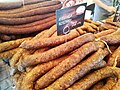 Kielbasa
 -
Chorizo

_(kielbasa).jpg)
See Also
External Links
- Sausage Recipes - The Spruce Eats
- Sausage: Nutrition, Calories, and Health Benefits - Eat This, Not That


