Menstrual cup: Difference between revisions
No edit summary |
CSV import |
||
| Line 33: | Line 33: | ||
[[Category:Menstruation]] | [[Category:Menstruation]] | ||
[[Category:Feminine hygiene]] | [[Category:Feminine hygiene]] | ||
<gallery> | |||
File:Менструальный диск и менструальная чаша (cropped).jpg|Menstrual cup | |||
File:CC-BY icon.svg|Menstrual cup | |||
File:Gray1166.png|Menstrual cup | |||
File:Undefined 14872.png|Menstrual cup | |||
File:Menstruationstasse im Roentgenbild 28W - CR pa - 001.jpg|Menstrual cup | |||
File:MRI with menstrual cup Frph-05-1162746-g005.jpg|Menstrual cup | |||
File:Cathole.png|Menstrual cup | |||
File:Menstrual cup use 10.1177 17455065211058553-fig1 (cropped to removal).jpg|Menstrual cup | |||
File:Gestion menstrual copita copa menstrual menstruación periodicas 02.jpg|Menstrual cup | |||
File:Stap4 (cropped text off).png|Menstrual cup | |||
File:Magdeburg hemispheres, drawing from Fotothek 0005669.jpg|Menstrual cup | |||
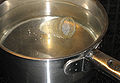
File:Boiling a menstrual cup2.jpg|Menstrual cup | |||
</gallery> | |||
Revision as of 01:30, 20 February 2025
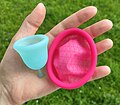
A menstrual cup is a reusable, eco-friendly menstrual hygiene product designed to collect menstrual fluid during a woman's menstrual cycle. Inserted into the vagina, it offers a safe and comfortable alternative to traditional sanitary products such as tampons and sanitary pads.
Design and Materials
Menstrual cups are typically bell-shaped and come with a stem or ring for ease of insertion and removal. Most cups are made from flexible, medical-grade silicone, although some may be made from latex or thermoplastic isomer. These materials ensure the cup is body-safe, hypoallergenic, and durable enough for long-term use.
Function
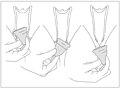
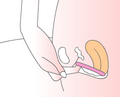
The menstrual cup is inserted into the vagina, where it forms a seal against the vaginal wall, just below the cervix. It collects menstrual fluid which is a mixture of uterine lining and other bodily fluids. Unlike tampons and pads, which absorb menstrual fluid, menstrual cups merely collect it, thereby reducing the risk of drying out the vaginal mucosa.
Usage
Depending on the user's menstrual flow, the cup is usually emptied, rinsed and reinserted every 4 to 12 hours. It is essential to keep the cup clean to maintain vaginal health and prevent infection. After each menstrual cycle, the cup should be sterilized and stored in a clean, dry place until the next use.
Advantages
Menstrual cups have several advantages over traditional menstrual hygiene products. They are environmentally friendly, as they reduce waste associated with disposable products. They can also be more cost-effective over time, given their reusable nature. Many women also find them more comfortable and convenient, and appreciate the longer wear time they offer.
Potential Challenges
Despite their many benefits, menstrual cups may present challenges for some women. These can include difficulty in insertion or removal, discomfort, or allergic reactions to the cup material. However, with appropriate guidance and practice, most women can learn to use menstrual cups effectively and comfortably.
References
See also
 | This medical article is a stub. You can help WikiMD by expanding the page. |
-
 Menstrual cup
 -
 Menstrual cup
 -
 Menstrual cup
 -
Menstrual cup
-
 Menstrual cup
 -
 Menstrual cup
 -
 Menstrual cup
 -
 Menstrual cup
 -
 Menstrual cup
 -
 Menstrual cup
 -
 Menstrual cup
 -
 Menstrual cup
.jpg)


.jpg)

.png)


