Gubernaculum: Difference between revisions
CSV import |
CSV import |
||
| Line 30: | Line 30: | ||
{{Anatomy-stub}} | {{Anatomy-stub}} | ||
<gallery> | |||
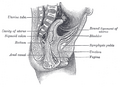
File:Gray1168.png|Gubernaculum | |||
</gallery> | |||
Latest revision as of 01:27, 20 February 2025

Gubernaculum
The gubernaculum is a structure in the development of the reproductive system in mammals. It plays a crucial role in the descent of the testes in males and the positioning of the ovaries in females.
Development[edit]
During embryonic development, the gubernaculum is a fibrous cord that extends from the lower pole of the gonad to the future inguinal region. In males, it guides the descent of the testes from the abdominal cavity into the scrotum. In females, it helps position the ovaries and later forms the round ligament of the uterus and the ovarian ligament.
Function in Males[edit]
In males, the gubernaculum shortens and thickens, pulling the testes through the inguinal canal into the scrotum. This process is essential for proper spermatogenesis, as the lower temperature of the scrotum is necessary for the production of viable sperm.
Function in Females[edit]
In females, the gubernaculum does not shorten to the same extent. Instead, it becomes the round ligament of the uterus and the ovarian ligament, which help to anchor the ovaries and the uterus in place within the pelvic cavity.
Clinical Significance[edit]
Abnormalities in the development or function of the gubernaculum can lead to conditions such as cryptorchidism (undescended testes) in males, which can affect fertility and increase the risk of testicular cancer. In females, improper development can lead to malpositioning of the ovaries, which may affect reproductive health.
See Also[edit]
References[edit]
<references group="" responsive="1"></references>

-
 Gubernaculum
