Mooncake: Difference between revisions
CSV import |
CSV import |
||
| Line 28: | Line 28: | ||
{{Chinese-food-stub}} | {{Chinese-food-stub}} | ||
{{food-stub}} | {{food-stub}} | ||
<gallery> | |||
File:Mooncake 3-4, lotus seed paste.jpg|Mooncake 3/4, lotus seed paste | |||
File:Lotus seed paste.jpg|Lotus seed paste | |||
File:Moon Cakes.jpg|Moon Cakes | |||
File:Mooncakes in Malaysia.jpg|Mooncakes in Malaysia | |||
File:Mooncake with double yolk and lotus seed paste.jpg|Mooncake with double yolk and lotus seed paste | |||
File:Mooncake with five smashed nuts.jpg|Mooncake with five smashed nuts | |||
File:Savoury Suzhou-style meat mooncake.jpg|Savoury Suzhou-style meat mooncake | |||
File:Yam mooncake1.jpg|Yam mooncake | |||
File:Moon Cake Filling.jpg|Moon Cake Filling | |||
File:Snow Skin Fruity Mooncakes.jpg|Snow Skin Fruity Mooncakes | |||
File:Pink jelly2.jpg|Pink jelly | |||
File:Mooncake Gift Sets in Singapore.jpg|Mooncake Gift Sets in Singapore | |||
</gallery> | |||
Latest revision as of 01:25, 20 February 2025
Mooncake is a traditional Chinese pastry, typically consumed during the Mid-Autumn Festival. The festival is for lunar appreciation and moon watching, and mooncakes are regarded as an indispensable delicacy. They are offered between friends or on family gatherings while celebrating the festival. The Mid-Autumn Festival is one of the four most important Chinese festivals.
History[edit]
The history of the mooncake dates back to the Tang Dynasty (618-907), when they were first used as a sacrificial offering to the moon. The custom of eating mooncakes during the festival began in the late Yuan Dynasty (1271-1368). The mooncake is not just a food, but more importantly, a profound cultural tradition embedded in the hearts of Chinese people, symbolizing family reunion and embodying spiritual feelings.
Ingredients and Preparation[edit]
Mooncakes are made from a variety of ingredients, with the most common being lotus seed paste and salted egg yolks. The pastry is often sweet, although savory versions are also popular. The process of making mooncakes requires careful preparation and skilled craftsmanship, including making the dough, preparing the filling, shaping the cakes, and baking.
Varieties[edit]
There are many regional varieties of mooncakes, including Cantonese, Beijing, and Suzhou styles. Cantonese mooncakes have a tender and slightly flaky crust, with fillings like lotus seed paste, melon seed paste, ham, chicken, duck, roast pork, mushrooms, and egg yolks. Beijing-style mooncakes are known for their delicate, meticulously crafted designs, while Suzhou-style mooncakes are famous for their crispy and buttery crust.
Cultural Significance[edit]
Mooncakes are deeply ingrained in Chinese culture and tradition. They are a symbol of reunion and happiness, and are often given as gifts to family and friends during the Mid-Autumn Festival. The round shape of the mooncake represents the full moon and the unity of the family.
See Also[edit]

-
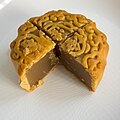 Mooncake 3/4, lotus seed paste
 -
 Lotus seed paste
 -
 Moon Cakes
 -
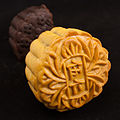 Mooncakes in Malaysia
 -
 Mooncake with double yolk and lotus seed paste
 -
 Mooncake with five smashed nuts
 -
 Savoury Suzhou-style meat mooncake
 -
 Yam mooncake
 -
 Moon Cake Filling
 -
 Snow Skin Fruity Mooncakes
 -
 Pink jelly
 -
 Mooncake Gift Sets in Singapore


