Mostarda: Difference between revisions
CSV import |
CSV import |
||
| Line 25: | Line 25: | ||
{{Italian cuisine}} | {{Italian cuisine}} | ||
{{food-stub}} | {{food-stub}} | ||
<gallery> | |||
File:Sapori mantovani - La mostarda di frutta.jpg|Mostarda | |||
</gallery> | |||
Latest revision as of 01:25, 20 February 2025
Mostarda is a traditional Italian condiment made of candied fruit and a mustard-flavoured syrup. It is typically served with boiled meats, the traditional dish of the Christmas holidays in the northern Italian regions. The term 'mostarda' refers to the spicy taste of mustard.
History[edit]
The origins of mostarda are ancient, dating back to the Roman times. The Romans used to macerate in must (unfermented grape juice) the fruits that were not consumed fresh. The term 'mostarda' derives from the Latin 'mustum ardens', which means 'spicy must'.
Preparation[edit]
The preparation of mostarda involves the use of fruits, sugar, and mustard essence. The fruits, which can vary according to the regional tradition, are left to macerate in sugar for a long period, then the mustard essence is added. The result is a syrupy condiment with a sweet and spicy taste.
Varieties[edit]
There are several varieties of mostarda, each typical of a specific Italian region. The most famous is the Mostarda di Cremona, which uses mixed fruits. Other varieties include the Mostarda di Mantova, made with small apples, and the Mostarda di Vicenza, made with quinces.
Serving[edit]
Mostarda is traditionally served with boiled meats, especially during the Christmas holidays. It can also be used as an ingredient in other dishes, such as the filling for the traditional tortellini.
See also[edit]
| Italian cuisine |
|---|
|
|

-
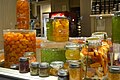 Mostarda

