Trapezoid: Difference between revisions
From WikiMD's Medical Encyclopedia
CSV import Tags: mobile edit mobile web edit |
CSV import |
||
| Line 63: | Line 63: | ||
File:Trapezium.svg|Trapezoid | File:Trapezium.svg|Trapezoid | ||
File:Temple_of_Dendur-_night.jpg|Trapezoid | File:Temple_of_Dendur-_night.jpg|Trapezoid | ||
</gallery> | |||
== Trapezoid == | |||
<gallery> | |||
File:Trapezoid.svg|Trapezoid | |||
File:Trapezium and Trapezoid, Hutton’s mistake in 1795.png|Trapezium and Trapezoid, Hutton’s mistake in 1795 | |||
File:Trapezoid 2 (PSF).png|Trapezoid 2 | |||
File:Trapezoid 3 (PSF).png|Trapezoid 3 | |||
File:Trapezoid special cases.png|Trapezoid special cases | |||
File:Trapez mittellinie en labels.svg|Trapez mittellinie en labels | |||
File:Trapez mittellinie en labels areas.svg|Trapez mittellinie en labels areas | |||
</gallery> | </gallery> | ||
Revision as of 01:13, 20 February 2025
Trapezoid
A trapezoid is a quadrilateral with at least one pair of parallel sides. In British English, the term "trapezium" is often used to refer to this shape, while in American English, "trapezium" refers to a quadrilateral with no parallel sides. The parallel sides are referred to as the "bases" of the trapezoid, and the non-parallel sides are called the "legs."
Properties
A trapezoid has several important properties:
- The midsegment (or median) of a trapezoid is parallel to the bases and its length is the average of the lengths of the bases.
- The area of a trapezoid can be calculated using the formula: \( A = \frac{1}{2} \times (b_1 + b_2) \times h \), where \( b_1 \) and \( b_2 \) are the lengths of the two bases, and \( h \) is the height (the perpendicular distance between the bases).
- If the legs of the trapezoid are equal in length, the trapezoid is called an isosceles trapezoid. An isosceles trapezoid has additional properties, such as equal angles adjacent to each base and equal diagonals.
Special Cases
- A parallelogram is a special case of a trapezoid where both pairs of opposite sides are parallel.
- A rectangle is a trapezoid with right angles.
- A square is a trapezoid with equal sides and right angles.
Etymology
The word "trapezoid" comes from the Greek word "trapezion," meaning "little table," which is derived from "trapeza," meaning "table." The term reflects the shape's resemblance to a table.
Related Pages
References
Gallery
-
 Diagram of a trapezoid
 -
 Comparison with a rhombus
 -
 Comparison with a rhomboid
 -
 Another trapezoid example
 -
 Trapezoid with labeled angles
 -
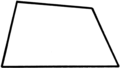 Trapezium in British English
 -
 Special cases of trapezoids
 -
 Trapezoid with midsegment labeled
 -
 Trapezoid with area calculation
 -
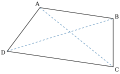 Trapezium in American English

.png)
.png)
.png)
.png)
.png)


-
Trapezoid
-
 Trapezium and Trapezoid, Hutton’s mistake in 1795
 -
Trapezoid
-
Trapezoid
-
Trapezoid
-
Trapezoid
-
Trapezoid
-
Trapezoid special cases
-
Trapezoid
-
Trapezoid
-
Trapezoid
-
 Trapezoid


Trapezoid
-
Trapezoid
-
Trapezium and Trapezoid, Hutton’s mistake in 1795
-
Trapezoid 2
-
Trapezoid 3
-
Trapezoid special cases
-
Trapez mittellinie en labels
-
Trapez mittellinie en labels areas
