Rotavirus: Difference between revisions
CSV import |
CSV import |
||
| Line 35: | Line 35: | ||
[[Category:Pediatrics]] | [[Category:Pediatrics]] | ||
[[Category:Virology]] | [[Category:Virology]] | ||
<gallery> | |||
File:Rotavirus Reconstruction.jpg|Rotavirus Reconstruction | |||
File:Rotavirus Structure.png|Rotavirus Structure | |||
File:Rotavirus with gold- labelled monoclonal antibody.jpg|Rotavirus with Gold-Labelled Monoclonal Antibody | |||
File:Rotavirus replication.png|Rotavirus Replication | |||
File:Multiple rotavirus particles.jpg|Multiple Rotavirus Particles | |||
File:Rotavirus infected gut.jpg|Rotavirus Infected Gut | |||
File:Rotavirus seasonal distribution.png|Rotavirus Seasonal Distribution | |||
File:Avertable-deaths-from-rotavirus-with-full-vaccine-coverage.png|Avertable Deaths from Rotavirus with Full Vaccine Coverage | |||
File:Flewett Rotavirus.jpg|Flewett Rotavirus | |||
</gallery> | |||
<gallery> | <gallery> | ||
File:Rotavirus Reconstruction.jpg|Rotavirus Reconstruction | File:Rotavirus Reconstruction.jpg|Rotavirus Reconstruction | ||
Revision as of 01:12, 20 February 2025
Rotavirus is a member of the Reoviridae family of viruses responsible for causing enteritis, a form of gastroenteritis. It's particularly common among infants and young children, causing severe diarrheal illness and, in some instances, contributing to significant morbidity and mortality.
Classification and Structure
Rotavirus belongs to the family Reoviridae and is non-enveloped with a genome composed of 11 segments of double-stranded RNA. Its viral particle exhibits a wheel-like appearance under electron microscopy, which explains its name, rotavirus, derived from the Latin word 'rota', meaning wheel.
Epidemiology
Rotavirus is a leading cause of severe diarrhea and dehydration among infants and young children worldwide. It's responsible for an estimated 200,000 deaths annually in children under five, particularly in low-income countries without widespread access to the rotavirus vaccine.
Transmission and Pathogenesis
Rotavirus is typically transmitted via the fecal-oral route. It damages the cells lining the small intestine, leading to malabsorption and diarrhea. Additionally, the virus stimulates the immune response, which can further contribute to diarrheal symptoms.
Clinical Presentation
Infants and young children infected with rotavirus present with severe, often watery diarrhea accompanied by vomiting, fever, and abdominal pain. Dehydration is a significant concern and the leading cause of morbidity and mortality associated with rotavirus infection.
Diagnosis and Treatment
Diagnosis of rotavirus infection is commonly made through the detection of the virus in stool samples using enzyme immunoassays. The primary treatment for rotavirus infection is supportive, focusing on hydration and electrolyte repletion.
Prevention
Prevention of rotavirus infection is primarily through vaccination. As of 2021, two oral vaccines are globally available: Rotarix and RotaTeq.
See Also
References
 | |
|---|---|
 |
 |
-
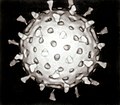 Rotavirus Reconstruction
 -
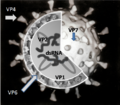 Rotavirus Structure
 -
 Rotavirus with Gold-Labelled Monoclonal Antibody
 -
 Rotavirus Replication
 -
 Multiple Rotavirus Particles
 -
 Rotavirus Infected Gut
 -
 Rotavirus Seasonal Distribution
 -
 Avertable Deaths from Rotavirus with Full Vaccine Coverage
 -
 Flewett Rotavirus


-
Rotavirus Reconstruction
-
Rotavirus Structure
-
Rotavirus with Gold-Labelled Monoclonal Antibody
-
Rotavirus Replication
-
Multiple Rotavirus Particles
-
Rotavirus Infected Gut
-
Rotavirus Seasonal Distribution
-
Avertable Deaths from Rotavirus with Full Vaccine Coverage
-
Flewett Rotavirus
