Refrigeration: Difference between revisions
CSV import Tags: mobile edit mobile web edit |
CSV import |
||
| Line 26: | Line 26: | ||
{{stub}} | {{stub}} | ||
== Refrigeration == | |||
<gallery> | |||
File:Kuehlregal USA.jpg|Refrigeration | |||
File:Ice Harvesting, Massachusetts, early 1850s.jpg|Ice Harvesting, Massachusetts, early 1850s | |||
File:William Cullen.jpg|William Cullen | |||
File:AppareilCarré.jpg|Appareil Carré | |||
File:Early refrigerator car design circa 1870.jpg|Early refrigerator car design circa 1870 | |||
File:AndrewMuhlPatent02.png|Andrew Muhl Patent | |||
File:SS Dunedin by Frederick Tudgay.JPG|SS Dunedin by Frederick Tudgay | |||
File:Early household refrigerator in Popular Science 1919.png|Early household refrigerator in Popular Science 1919 | |||
File:Food into a refrigerator - 20111002.jpg|Food into a refrigerator | |||
File:Refrigeration.png|Refrigeration | |||
File:RefrigerationTS.png|Refrigeration | |||
</gallery> | |||
Latest revision as of 01:08, 20 February 2025
Refrigeration is a process that removes heat from a space, substance, or system to lower and/or maintain its temperature below the ambient one. In other words, refrigeration means artificial (human-made) cooling. Heat is removed from a low-temperature reservoir and transferred to a high-temperature reservoir. The work of heat transport is traditionally driven by mechanical means, but can also be driven by heat, magnetism, electricity, laser, or other means.
History[edit]
The concept of refrigeration has been around for many centuries, with evidence of ice and snow being used for cooling as far back as 1000 BC in China. The modern era of refrigeration began in the mid-19th century with the inventions of James Harrison, Alexander Twining, and Jacob Perkins, who developed the first practical refrigeration systems.
Principles[edit]
Refrigeration works by exploiting the physical properties of gases. When a gas expands, it absorbs heat, and when it is compressed, it releases heat. This is the principle behind most refrigeration systems.
Applications[edit]
Refrigeration has many applications, including, but not limited to, household refrigerators, industrial freezers, cryogenics, and air conditioning. Heat pumps may use the heat output of the refrigeration process, and also may be designed to be reversible, but are otherwise similar to air conditioning units.
Environmental Impact[edit]
Refrigeration systems have been identified as a significant source of greenhouse gases due to their use of hydrofluorocarbons (HFCs) as a coolant. Efforts are being made to phase out these substances and replace them with more environmentally friendly alternatives.
See Also[edit]
 | This medical article is a stub. You can help WikiMD by expanding the page. |
Refrigeration[edit]
-
 Refrigeration
 -
 Ice Harvesting, Massachusetts, early 1850s
 -
 William Cullen
 -
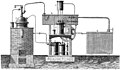 Appareil Carré
 -
 Early refrigerator car design circa 1870
 -
 Andrew Muhl Patent
 -
 SS Dunedin by Frederick Tudgay
 -
 Early household refrigerator in Popular Science 1919
 -
 Food into a refrigerator
 -
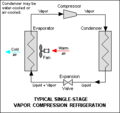 Refrigeration
 -
 Refrigeration


