Cuboid fracture: Difference between revisions
CSV import |
CSV import |
||
| Line 28: | Line 28: | ||
{{medicine-stub}} | {{medicine-stub}} | ||
<gallery> | |||
File:CuboidAvulsionFracture.jpg|Cuboid fracture | |||
File:AvulsionofCuboid.jpg|Cuboid fracture | |||
</gallery> | |||
Revision as of 00:56, 20 February 2025
Cuboid Fracture
A cuboid fracture is a type of bone fracture involving the cuboid bone, one of the seven tarsal bones located in the lateral part of the foot. This injury is relatively rare compared to other foot fractures and can occur due to direct impact or as a result of excessive force transmitted along the bones of the foot, often seen in athletes or individuals experiencing a high-energy trauma.
Causes
Cuboid fractures typically result from two main mechanisms: direct impact and compressive forces. Direct impact can occur from a fall or a heavy object striking the foot, while compressive forces are usually the result of an awkward landing, often seen in sports-related activities. Additionally, overuse and repetitive stress can lead to stress fractures in the cuboid bone.
Symptoms
Common symptoms of a cuboid fracture include pain and tenderness over the lateral side of the foot, swelling, bruising, and difficulty bearing weight on the affected foot. In some cases, visible deformity may be present if the fracture is severe or if there are associated dislocations.
Diagnosis
Diagnosis of a cuboid fracture involves a thorough medical history and physical examination, followed by imaging studies. X-rays are the primary imaging modality used to identify fractures of the cuboid bone. In some cases, a CT scan or MRI may be recommended to assess the extent of the injury and to rule out associated injuries to the soft tissues or adjacent bones.
Treatment
Treatment of cuboid fractures depends on the severity and type of the fracture. Non-displaced fractures can often be managed conservatively with immobilization in a cast or boot for a period of time, followed by physical therapy to restore strength and mobility. Weight-bearing is usually restricted initially to allow the bone to heal.
For displaced fractures or those involving significant damage to the surrounding structures, surgical intervention may be necessary. Surgery typically involves the use of pins, screws, or plates to stabilize the fracture and allow for proper healing.
Recovery
The recovery time for a cuboid fracture varies depending on the severity of the fracture and the treatment method. Non-surgical treatment may require immobilization for 6 to 8 weeks, followed by a gradual return to activity. Surgical treatment may involve a longer recovery period, with a gradual increase in weight-bearing and physical therapy to restore function.
Prevention
Preventive measures for cuboid fractures include wearing appropriate footwear, especially during high-impact sports, maintaining good muscle strength and flexibility, and avoiding activities that put excessive stress on the feet.

-
 Cuboid fracture
 -
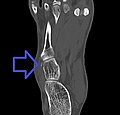 Cuboid fracture


