COVID-19 vaccine: Difference between revisions
CSV import |
CSV import |
||
| Line 26: | Line 26: | ||
{{Medicine-stub}} | {{Medicine-stub}} | ||
<gallery> | |||
File:Corona vaccination mechanism.webm|Corona vaccination mechanism | |||
File:COVID-19 vaccine doses administered by continent.svg|COVID-19 vaccine doses administered by continent | |||
File:World map of share of people who received all doses prescribed by the initial COVID-19 vaccination protocol.png|World map of share of people who received all doses prescribed by the initial COVID-19 vaccination protocol | |||
File:COVID Vaccine (50745583447).jpg|COVID Vaccine | |||
File:COVID-19 vaccine map.svg|COVID-19 vaccine map | |||
File:Vaccine candidate mechanisms for SARS-CoV-2 (49948301838).jpg|Vaccine candidate mechanisms for SARS-CoV-2 | |||
File:Fimmu-11-579250-g004.jpg|Fimmu-11-579250-g004 | |||
File:RNA vaccine illustration (en).jpg|RNA vaccine illustration | |||
File:2021- COVID-19 death rates by vaccination status - US.svg|2021 COVID-19 death rates by vaccination status - US | |||
File:COVID-19 vaccines lives saved.png|COVID-19 vaccines lives saved | |||
File:World map of share of people who received at least one dose of COVID-19 vaccine by country.png|World map of share of people who received at least one dose of COVID-19 vaccine by country | |||
</gallery> | |||
Latest revision as of 00:52, 20 February 2025
COVID-19 vaccine refers to a vaccine that aims to provide acquired immunity against SARS-CoV-2, the virus that causes coronavirus disease 2019 (COVID-19). The development of these vaccines has been a pivotal part of the global response to the COVID-19 pandemic. As of early 2023, multiple COVID-19 vaccines have been authorized for emergency use or fully approved by various regulatory agencies around the world.
Development and Approval[edit]
The development of the COVID-19 vaccines progressed at an unprecedented speed, with several vaccines entering clinical trials by early 2020. This rapid development was facilitated by prior research on coronaviruses, advancements in vaccine technology, and significant global investment. The vaccines that have received the most attention include mRNA vaccines, such as the Pfizer-BioNTech and Moderna vaccines, viral vector vaccines like the Oxford-AstraZeneca and Johnson & Johnson vaccines, and inactivated virus vaccines, such as CoronaVac and Sinopharm.
Mechanism of Action[edit]
COVID-19 vaccines work by stimulating the body's immune system to recognize and fight the virus. mRNA vaccines use a snippet of the virus's genetic material to instruct cells to produce a harmless piece of the virus called the spike protein, prompting an immune response. Viral vector vaccines use a different, harmless virus to deliver genetic material that codes for the spike protein. Inactivated virus vaccines contain the killed virus, which cannot cause disease but can still stimulate an immune response.
Efficacy and Safety[edit]
Clinical trials have shown that COVID-19 vaccines are effective in preventing COVID-19 disease, particularly severe illness and death. The efficacy rates vary among the vaccines, but most offer substantial protection against COVID-19. Safety monitoring has been an integral part of the vaccine rollout, with rare adverse events being thoroughly investigated. The benefits of vaccination in preventing COVID-19 illness and its complications far outweigh the risks of potential side effects for the vast majority of people.
Distribution and Access[edit]
The global distribution of COVID-19 vaccines has been uneven, with high-income countries securing the majority of early vaccine supplies. This disparity has led to calls for more equitable access to vaccines through initiatives like COVAX, which aims to provide vaccines to low- and middle-income countries. Vaccination strategies have varied by country, with most prioritizing healthcare workers, the elderly, and those with high-risk medical conditions.
Future Directions[edit]
As the virus continues to evolve, with new variants emerging, ongoing research and adaptation of vaccines may be necessary. Booster doses have been recommended in many countries to enhance or prolong immunity, especially in the face of variants that may partially evade the initial immune response. Research into next-generation vaccines, including nasal vaccines and vaccines targeting multiple variants, is ongoing.
See Also[edit]

-
 Corona vaccination mechanism
 -
 COVID-19 vaccine doses administered by continent
 -
 World map of share of people who received all doses prescribed by the initial COVID-19 vaccination protocol
 -
 COVID Vaccine
 -
 COVID-19 vaccine map
 -
 Vaccine candidate mechanisms for SARS-CoV-2
 -
 Fimmu-11-579250-g004
 -
 RNA vaccine illustration
 -
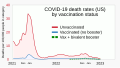 2021 COVID-19 death rates by vaccination status - US
 -
 COVID-19 vaccines lives saved
 -
 World map of share of people who received at least one dose of COVID-19 vaccine by country


.jpg)

.jpg)

.jpg)


