Canberra: Difference between revisions
CSV import Tags: mobile edit mobile web edit |
CSV import |
||
| Line 31: | Line 31: | ||
[[Category:Canberra]] | [[Category:Canberra]] | ||
[[Category:Cities in Australia]] | [[Category:Cities in Australia]] | ||
== Canberra == | |||
<gallery> | |||
File:Canberra panorama from Mount Ainslie.jpg|Canberra panorama from Mount Ainslie | |||
File:National Carillon, Canberra ACT (2).jpg|National Carillon, Canberra | |||
File:Australian War Memorial Canberra, ACT (2).jpg|Australian War Memorial, Canberra | |||
File:Parliament House, National Library of Australia, Canberra, 2023 (2).jpg|Parliament House and National Library of Australia, Canberra | |||
File:Entrance to the National Gallery of Australia February 2013.jpg|Entrance to the National Gallery of Australia | |||
File:Old and new Parliament Houses; Canberra Australia.jpg|Old and new Parliament Houses, Canberra | |||
File:Free printable and editable vector map of Canberra Australia.svg|Map of Canberra, Australia | |||
File:Canberra viewed from Mount Ainslie.jpg|Canberra viewed from Mount Ainslie | |||
</gallery> | |||
Latest revision as of 00:51, 20 February 2025


Canberra is the capital city of Australia, known for its distinctive design and significant cultural institutions. It is located in the Australian Capital Territory (ACT), which is entirely surrounded by the state of New South Wales. Canberra was selected as the capital in 1908 as a compromise between the two largest Australian cities, Sydney and Melbourne. The city's design was influenced by the garden city movement, and it was planned by the American architect Walter Burley Griffin in collaboration with his wife, Marion Mahony Griffin. Canberra officially became the seat of government on 12 March 1913.
History[edit]
The region now known as Canberra has been inhabited by Indigenous Australians for over 20,000 years, with the local group being the Ngunnawal people. European exploration and settlement began in the 1820s, but it wasn't until the 20th century that Canberra was chosen as the site for the new national capital. The selection was the result of a long dispute over whether Sydney or Melbourne should be the capital of Australia. As a compromise, it was decided that a new city would be built to serve as the capital.
Design and Development[edit]
The design of Canberra was selected through an international competition won by Walter Burley Griffin and Marion Mahony Griffin in 1912. Their plan featured geometric motifs and was centered around axes aligned with significant topographical landmarks in the Australian landscape. The city's layout was influenced by the garden city movement, which aimed to combine the benefits of the city and the countryside by surrounding homes with greenery and emphasizing a connection to nature.
Government and Politics[edit]
As the capital city, Canberra is the political center of Australia. It is home to the Parliament House, the High Court of Australia, and numerous government departments and agencies. The Australian Capital Territory also has its own local government, but it has more limited powers compared to the states of Australia.
Culture and Attractions[edit]
Canberra is known for its national monuments and institutions, including the Australian War Memorial, the National Gallery of Australia, the National Museum of Australia, and the Australian National Botanic Gardens. The city also hosts the annual Floriade festival, which showcases flowers and plants from around the world.
Education[edit]
The city is a center for education and home to several universities, including the Australian National University (ANU) and the University of Canberra. ANU is consistently ranked among the top universities in the world.
Economy[edit]
Canberra's economy is primarily based on public administration and safety, which accounts for a significant portion of employment in the city. However, there is also a growing private sector, particularly in the areas of information technology, defense, and education.
Demographics[edit]
Canberra has a diverse population, with a significant portion of residents born overseas. The city is known for its high standard of living, with residents enjoying access to extensive public services and amenities.
Transport[edit]
The city is served by the Canberra Airport, while public transport within Canberra includes buses and a recently introduced light rail network. The road system is designed with a series of concentric circles and radiating avenues, reflecting the Griffin plan.
Conclusion[edit]
Canberra stands as a unique city, not just within Australia but globally, due to its planned nature, political significance, and commitment to the garden city movement. It continues to grow and evolve, maintaining its status as a vibrant and important national capital.
Canberra[edit]
-
 Canberra panorama from Mount Ainslie
 -
 National Carillon, Canberra
 -
 Australian War Memorial, Canberra
 -
 Parliament House and National Library of Australia, Canberra
 -
 Entrance to the National Gallery of Australia
 -
 Old and new Parliament Houses, Canberra
 -
 Map of Canberra, Australia
 -
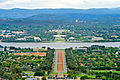 Canberra viewed from Mount Ainslie

.jpg)
.jpg)
.jpg)


