Sprained ankle: Difference between revisions
CSV import |
CSV import |
||
| Line 50: | Line 50: | ||
{{stub}} | {{stub}} | ||
<gallery> | |||
File:Ankle en.svg|Ankle anatomy | |||
File:Freshspraininbrace.JPG|Fresh sprain in brace | |||
File:Schwellung am Fußknloechel und Blutergussl.jpg|Swelling and bruising of the ankle | |||
File:Ankle Inversion.jpg|Ankle inversion | |||
File:Ankle brace for grade I or II.jpg|Ankle brace for grade I or II sprain | |||
File:Rehabilitation Exercises for an ankle sprain.jpg|Rehabilitation exercises for an ankle sprain | |||
File:Adolescents vs general population ankle sprain incidences.jpg|Adolescents vs general population ankle sprain incidences | |||
File:Ankle Sprain Epidemiology- U.S. Military vs General Population.jpg|Ankle sprain epidemiology: U.S. Military vs General Population | |||
File:Ankle sprain incidence rates of average males to females.jpg|Ankle sprain incidence rates of average males to females | |||
</gallery> | |||
Revision as of 00:47, 20 February 2025
Sprained ankle is a common medical condition that involves the tearing of the ligaments of the ankle. It typically occurs when the ankle is twisted or turned in an awkward way. This can stretch or tear the ligaments that hold the ankle bones together.
Causes
A sprained ankle can be caused by a variety of factors, including:
- Twisting the ankle
- Rolling the ankle
- Awkwardly landing on the foot
- Walking or running on uneven surfaces
- Participating in sports that require cutting actions or rolling and twisting of the foot, such as soccer, football, basketball, and tennis.
Symptoms
The symptoms of a sprained ankle can vary depending on the severity of the injury. They may include:
- Pain, especially when you bear weight on the affected foot
- Tenderness when you touch the ankle
- Swelling
- Bruising
- Restricted range of motion
- Instability in the ankle
- Popping sensation or sound at the time of injury
Diagnosis
A doctor or medical professional will diagnose a sprained ankle by performing a physical examination and asking about the circumstances of the injury. Imaging tests such as X-rays, MRI scans, or CT scans may be used to rule out a broken bone or other injuries.
Treatment
Treatment for a sprained ankle depends on the severity of the injury. It may include:
- Resting the ankle
- Ice application
- Compression bandages
- Elevation of the foot
- Pain relievers
- Physical therapy
- In severe cases, surgery may be required
Prevention
Prevention strategies for a sprained ankle include:
- Wearing supportive shoes
- Avoiding uneven surfaces
- Warming up before exercising
- Using caution during activities that can cause the ankle to twist
- Strengthening the muscles around the ankle
See also
 | |
|---|---|
 |
 |
-
 Ankle anatomy
 -
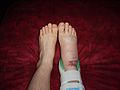 Fresh sprain in brace
 -
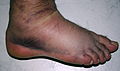 Swelling and bruising of the ankle
 -
 Ankle inversion
 -
 Ankle brace for grade I or II sprain
 -
 Rehabilitation exercises for an ankle sprain
 -
 Adolescents vs general population ankle sprain incidences
 -
Ankle sprain epidemiology: U.S. Military vs General Population
-
Ankle sprain incidence rates of average males to females


