Arylsulfatase B: Difference between revisions
CSV import |
CSV import |
||
| Line 30: | Line 30: | ||
{{genetics-stub}} | {{genetics-stub}} | ||
{{medicine-stub}} | {{medicine-stub}} | ||
== Arylsulfatase B == | |||
<gallery> | |||
File:Arylsulfatase B.jpg|Arylsulfatase B | |||
File:Arylsulfatase B hydropathy plot.png|Arylsulfatase B hydropathy plot | |||
</gallery> | |||
Latest revision as of 00:47, 20 February 2025
Arylsulfatase B (ARSB), also known as N-acetylgalactosamine-4-sulfatase, is an enzyme that is encoded by the ARSB gene in humans. This enzyme plays a crucial role in the degradation of glycosaminoglycans (GAGs) such as dermatan sulfate and chondroitin sulfate.
Function[edit]
Arylsulfatase B is a member of the sulfatase family. It is a lysosomal enzyme that catalyzes the hydrolysis of the 4-sulfate groups from the N-acetylgalactosamine 4-sulfate units of dermatan sulfate and chondroitin sulfate. This process is a necessary step in the catabolism of these GAGs.
Clinical significance[edit]
Deficiency of this enzyme results in the accumulation of undegraded GAGs in cells and extracellular matrix, leading to the lysosomal storage disorder mucopolysaccharidosis type VI (MPS VI), also known as Maroteaux-Lamy syndrome. MPS VI is a progressive condition that affects multiple systems of the body. Symptoms can range from mild to severe and may include skeletal abnormalities, heart valve disease, and impaired vision.
Genetics[edit]
The ARSB gene is located on the long (q) arm of chromosome 5 at position 13.3. Mutations in this gene are associated with MPS VI. More than 130 mutations in the ARSB gene have been identified, most of which change single amino acids in arylsulfatase B.
See also[edit]
References[edit]
<references group="" responsive="1"></references>


Arylsulfatase B[edit]
-
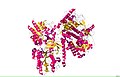 Arylsulfatase B
 -
 Arylsulfatase B hydropathy plot


