Beeturia: Difference between revisions
CSV import |
CSV import |
||
| Line 24: | Line 24: | ||
{{medicine-stub}} | {{medicine-stub}} | ||
<gallery> | |||
File:Betanin.svg|Beeturia | |||
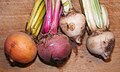
File:Uncommon beetroot colours.jpg|Beeturia | |||
</gallery> | |||
Latest revision as of 00:45, 20 February 2025
Beeturia is a phenomenon where the consumption of beetroot or foods colored with beetroot extract causes the urine to become pink or red. It is a harmless condition, but it can be alarming for individuals who are unaware of its cause.
Causes[edit]
Beeturia is caused by the presence of a compound called betanin in the beetroot. Betanin is a red pigment that is not broken down in the body and is excreted in the urine. The intensity of the color can vary depending on the individual's stomach acid and the presence of other foods in the stomach.
Prevalence[edit]
Beeturia is more common in individuals with low stomach acid, such as those who are taking proton pump inhibitors or other medications that reduce stomach acid. It is also more common in individuals with certain genetic traits that affect the metabolism of betanin.
Diagnosis[edit]
The diagnosis of beeturia is usually made based on the patient's history of beetroot consumption and the appearance of the urine. In some cases, a urine test may be performed to confirm the presence of betanin.
Treatment[edit]
No treatment is necessary for beeturia. It is a harmless condition and will resolve on its own once the beetroot has been fully digested and excreted.
See also[edit]

-
 Beeturia
 -
 Beeturia


