BENTA disease: Difference between revisions
No edit summary |
CSV import |
||
| Line 29: | Line 29: | ||
<references/> | <references/> | ||
[[Category:Autoimmune diseases]] | [[Category:Autoimmune diseases]] | ||
<gallery> | |||
File:Autosomal Dominant Inheritance.jpeg|BENTA disease | |||
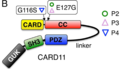
File:CARD11.tiff|BENTA disease | |||
</gallery> | |||
Revision as of 00:42, 20 February 2025
BENTA Disease
BENTA disease is a rare genetic disorder affecting the immune system. The acronym BENTA stands for "B cell expansion with NF-κB and T cell anergy." It is characterized by a germline heterozygous gain-of-function mutation in the CARD11 gene (OMIM entry #607210). This disorder manifests as polyclonal B cell lymphocytosis beginning in infancy, splenomegaly, lymphadenopathy, mild immunodeficiency, and an increased risk of lymphoma.
Causes
BENTA disease is caused by gain-of-function mutations in the CARD11 gene. These mutations lead to an increase in NF-κB signaling, which is crucial for immune cell activation and survival. The mutations are heterozygous, meaning only one of the two copies of the gene in each cell is altered.
Characteristics
The primary characteristics of BENTA disease include:
- Polyclonal B cell lymphocytosis with onset in infancy
- Splenomegaly
- Lymphadenopathy
- Mild immunodeficiency
- Increased risk of lymphoma
Patients may exhibit symptoms related to the enlargement of the spleen and lymph nodes, as well as recurrent infections due to immunodeficiency.
History
BENTA disease was first characterized in 2012 by investigators Andrew L. Snow and Michael J. Lenardo at the National Institute of Allergy and Infectious Disease, part of the U.S. National Institutes of Health. Their groundbreaking work identified the underlying genetic mutations responsible for the disorder and its primary effects on the immune system.
Current Research
Dr. Andrew L. Snow, now at the Uniformed Services University of the Health Sciences, continues to study BENTA disease. Current research efforts are focused on understanding the precise mechanisms by which CARD11 mutations lead to the disease's characteristic immune abnormalities and exploring potential therapeutic strategies to manage or cure it.
External Links
- OMIM Entry #607210
- National Institute of Allergy and Infectious Disease
- Uniformed Services University of the Health Sciences
References
<references/>
-
 BENTA disease
 -
 BENTA disease

