Amanita calyptroderma: Difference between revisions
CSV import |
CSV import |
||
| Line 4: | Line 4: | ||
File:Amanita_capyotroderma_group_Oakland.JPG|Group of Amanita calyptroderma in Oakland | File:Amanita_capyotroderma_group_Oakland.JPG|Group of Amanita calyptroderma in Oakland | ||
</gallery> | </gallery> | ||
==Amanita calyptroderma== | |||
'''''Amanita calyptroderma''''', commonly known as the coccora or coccoli, is a species of [[fungus]] in the [[Amanita]] genus. It is a [[basidiomycete]] fungus, which is notable for its distinctive appearance and its edibility when properly prepared. This species is found primarily in the western regions of North America, particularly in [[California]] and the Pacific Northwest. | |||
===Description=== | |||
''Amanita calyptroderma'' is characterized by its large, fleshy [[fruiting body]]. The [[cap]] is typically 8–20 cm in diameter, and it is initially covered by a universal veil that breaks apart as the mushroom matures, leaving a distinctive volva at the base of the [[stipe]]. The cap is convex to flat, with a smooth surface that can be white to pale orange or tan in color. The [[gills]] are free from the stipe and are white to cream-colored. | |||
The stipe, or stem, is 10–20 cm tall and 1–3 cm thick, with a bulbous base. It is white and may have a ring, or annulus, which is a remnant of the partial veil. The volva at the base is a key identifying feature, appearing as a sac-like structure that encloses the base of the stipe. | |||
===Habitat and Distribution=== | |||
''Amanita calyptroderma'' is typically found in [[coniferous]] and [[mixed forest]]s, often in association with [[oak]] and [[pine]] trees. It is a mycorrhizal species, forming symbiotic relationships with the roots of trees. This species is most commonly found in the fall, particularly after the first rains of the season. | |||
===Edibility=== | |||
While many species in the Amanita genus are highly toxic, ''Amanita calyptroderma'' is considered edible when properly prepared. However, caution is advised due to the potential for confusion with other toxic Amanita species. It is important to ensure accurate identification before consumption. The mushroom is often cooked before eating, as this can help to eliminate any potential toxins. | |||
===Similar Species=== | |||
''Amanita calyptroderma'' can be confused with other Amanita species, such as ''[[Amanita phalloides]]'' (the death cap) and ''[[Amanita ocreata]]'' (the destroying angel), both of which are highly toxic. Key distinguishing features include the color and texture of the cap, the presence of a volva, and the habitat in which the mushroom is found. | |||
==Related pages== | |||
* [[Amanita]] | |||
* [[Mycology]] | |||
* [[Fungal ecology]] | |||
* [[Mushroom poisoning]] | |||
{{Amanita}} | |||
[[Category:Amanita|calyptroderma]] | |||
[[Category:Edible fungi]] | |||
[[Category:Fungi of North America]] | |||
Revision as of 00:41, 19 February 2025
Amanita_calyptroderma
-
 Amanita calyptroderma in Oakland
 -
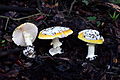 Group of Amanita calyptroderma in Oakland


Amanita calyptroderma
Amanita calyptroderma, commonly known as the coccora or coccoli, is a species of fungus in the Amanita genus. It is a basidiomycete fungus, which is notable for its distinctive appearance and its edibility when properly prepared. This species is found primarily in the western regions of North America, particularly in California and the Pacific Northwest.
Description
Amanita calyptroderma is characterized by its large, fleshy fruiting body. The cap is typically 8–20 cm in diameter, and it is initially covered by a universal veil that breaks apart as the mushroom matures, leaving a distinctive volva at the base of the stipe. The cap is convex to flat, with a smooth surface that can be white to pale orange or tan in color. The gills are free from the stipe and are white to cream-colored.
The stipe, or stem, is 10–20 cm tall and 1–3 cm thick, with a bulbous base. It is white and may have a ring, or annulus, which is a remnant of the partial veil. The volva at the base is a key identifying feature, appearing as a sac-like structure that encloses the base of the stipe.
Habitat and Distribution
Amanita calyptroderma is typically found in coniferous and mixed forests, often in association with oak and pine trees. It is a mycorrhizal species, forming symbiotic relationships with the roots of trees. This species is most commonly found in the fall, particularly after the first rains of the season.
Edibility
While many species in the Amanita genus are highly toxic, Amanita calyptroderma is considered edible when properly prepared. However, caution is advised due to the potential for confusion with other toxic Amanita species. It is important to ensure accurate identification before consumption. The mushroom is often cooked before eating, as this can help to eliminate any potential toxins.
Similar Species
Amanita calyptroderma can be confused with other Amanita species, such as Amanita phalloides (the death cap) and Amanita ocreata (the destroying angel), both of which are highly toxic. Key distinguishing features include the color and texture of the cap, the presence of a volva, and the habitat in which the mushroom is found.
