American cockroach: Difference between revisions
CSV import |
CSV import |
||
| Line 7: | Line 7: | ||
File:Anoplolepis_gracilipes_moving_Blattidae_sp._toward_nest.jpg|American cockroach | File:Anoplolepis_gracilipes_moving_Blattidae_sp._toward_nest.jpg|American cockroach | ||
</gallery> | </gallery> | ||
== American Cockroach == | |||
The '''American cockroach''' (''Periplaneta americana'') is a common [[species]] of [[cockroach]] that is often considered a [[pest]] in urban environments. Despite its name, the American cockroach is not native to [[North America]]; it is believed to have originated in [[Africa]] and was introduced to the [[United States]] in the early 1600s. | |||
== Description == | |||
The American cockroach is the largest species of common cockroach, with adults typically measuring about 30–50 mm (1.2–2.0 in) in length. They are reddish-brown in color with a yellowish margin on the [[pronotum]], which is the shield-like structure that covers part of the head. Both male and female American cockroaches have well-developed wings and are capable of [[flight]], although they are more likely to run when disturbed. | |||
== Habitat == | |||
American cockroaches are highly adaptable and can thrive in a variety of environments. They are commonly found in [[sewers]], [[basements]], and other warm, moist areas. In urban settings, they are often found in [[commercial buildings]], [[restaurants]], and [[homes]], particularly in areas where food is stored or prepared. They prefer temperatures between 70 and 80 degrees Fahrenheit and are less active in cooler environments. | |||
== Behavior == | |||
American cockroaches are primarily [[nocturnal]] and are most active at night. They are omnivorous scavengers, feeding on a wide range of organic materials, including [[decaying matter]], [[food scraps]], and even other insects. They are known for their ability to survive in harsh conditions and can go without food for up to a month, although they require water more frequently. | |||
== Reproduction == | |||
The reproductive cycle of the American cockroach involves the laying of [[egg cases]], known as oothecae. Each ootheca contains approximately 16 eggs and is deposited in a safe, hidden location. The eggs hatch into [[nymphs]], which undergo several molts before reaching adulthood. The entire life cycle from egg to adult can take about 6 months to a year, depending on environmental conditions. | |||
== Health Implications == | |||
American cockroaches are considered a public health concern because they can spread [[disease]] and trigger [[allergies]]. They are known to carry [[pathogens]] such as [[bacteria]], [[viruses]], and [[fungi]] on their bodies, which can contaminate food and surfaces. Their shed skins and droppings can also contribute to [[asthma]] and allergic reactions in sensitive individuals. | |||
== Control and Management == | |||
Effective control of American cockroach populations involves a combination of [[sanitation]], [[exclusion]], and [[chemical control]] methods. Reducing food and water sources, sealing entry points, and using insecticides can help manage infestations. Professional pest control services may be necessary for severe infestations. | |||
== Related Pages == | |||
* [[Cockroach]] | |||
* [[Pest control]] | |||
* [[Insect]] | |||
* [[Urban ecology]] | |||
{{Cockroaches}} | |||
[[Category:Cockroaches]] | |||
[[Category:Invasive species]] | |||
[[Category:Household pest insects]] | |||
Latest revision as of 00:40, 19 February 2025
-
 American cockroach
 -
 American cockroach performing a high-speed inversion
 -
 American cockroach
 -
 American cockroach
 -
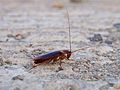 American cockroach
 -
 American cockroach


American Cockroach[edit]
The American cockroach (Periplaneta americana) is a common species of cockroach that is often considered a pest in urban environments. Despite its name, the American cockroach is not native to North America; it is believed to have originated in Africa and was introduced to the United States in the early 1600s.
Description[edit]
The American cockroach is the largest species of common cockroach, with adults typically measuring about 30–50 mm (1.2–2.0 in) in length. They are reddish-brown in color with a yellowish margin on the pronotum, which is the shield-like structure that covers part of the head. Both male and female American cockroaches have well-developed wings and are capable of flight, although they are more likely to run when disturbed.
Habitat[edit]
American cockroaches are highly adaptable and can thrive in a variety of environments. They are commonly found in sewers, basements, and other warm, moist areas. In urban settings, they are often found in commercial buildings, restaurants, and homes, particularly in areas where food is stored or prepared. They prefer temperatures between 70 and 80 degrees Fahrenheit and are less active in cooler environments.
Behavior[edit]
American cockroaches are primarily nocturnal and are most active at night. They are omnivorous scavengers, feeding on a wide range of organic materials, including decaying matter, food scraps, and even other insects. They are known for their ability to survive in harsh conditions and can go without food for up to a month, although they require water more frequently.
Reproduction[edit]
The reproductive cycle of the American cockroach involves the laying of egg cases, known as oothecae. Each ootheca contains approximately 16 eggs and is deposited in a safe, hidden location. The eggs hatch into nymphs, which undergo several molts before reaching adulthood. The entire life cycle from egg to adult can take about 6 months to a year, depending on environmental conditions.
Health Implications[edit]
American cockroaches are considered a public health concern because they can spread disease and trigger allergies. They are known to carry pathogens such as bacteria, viruses, and fungi on their bodies, which can contaminate food and surfaces. Their shed skins and droppings can also contribute to asthma and allergic reactions in sensitive individuals.
Control and Management[edit]
Effective control of American cockroach populations involves a combination of sanitation, exclusion, and chemical control methods. Reducing food and water sources, sealing entry points, and using insecticides can help manage infestations. Professional pest control services may be necessary for severe infestations.
Related Pages[edit]
