Ancylostoma caninum: Difference between revisions
CSV import |
CSV import |
||
| Line 6: | Line 6: | ||
File:Dog_kennel_Mason.jpg|Ancylostoma caninum | File:Dog_kennel_Mason.jpg|Ancylostoma caninum | ||
</gallery> | </gallery> | ||
==Ancylostoma caninum== | |||
'''Ancylostoma caninum''' is a species of [[hookworm]] that primarily infects [[canine|dogs]], but can also affect other [[mammals]], including humans. It is a parasitic [[nematode]] that resides in the [[small intestine]] of its host, where it attaches to the intestinal wall and feeds on blood, leading to [[anemia]] and other health issues. | |||
==Life Cycle== | |||
The life cycle of ''Ancylostoma caninum'' involves several stages: | |||
# '''Eggs''': The adult female hookworm lays eggs in the host's intestine, which are then excreted in the [[feces]]. | |||
# '''Larvae''': The eggs hatch in the environment, releasing larvae. These larvae undergo several molts, developing into infective third-stage larvae. | |||
# '''Infection''': The infective larvae can penetrate the skin of a new host or be ingested. Once inside the host, they migrate to the lungs, are coughed up, swallowed, and eventually reach the small intestine. | |||
# '''Maturation''': In the small intestine, the larvae mature into adult worms, completing the cycle. | |||
==Pathogenesis== | |||
''Ancylostoma caninum'' causes [[hookworm disease]] in dogs, characterized by symptoms such as [[diarrhea]], [[weight loss]], and [[lethargy]]. The worms attach to the intestinal mucosa, causing blood loss and leading to [[iron deficiency anemia]]. In severe cases, especially in puppies, the infection can be fatal. | |||
==Zoonotic Potential== | |||
''Ancylostoma caninum'' is of zoonotic concern, meaning it can infect humans. The larvae can penetrate human skin, causing a condition known as [[cutaneous larva migrans]], characterized by itchy, serpiginous tracks on the skin. Although the larvae do not mature into adult worms in humans, the condition can be uncomfortable and requires medical attention. | |||
==Diagnosis== | |||
Diagnosis of ''Ancylostoma caninum'' infection is typically made through [[fecal examination]] to identify hookworm eggs. In some cases, blood tests may be used to assess the severity of anemia and other related conditions. | |||
==Treatment and Control== | |||
Treatment of ''Ancylostoma caninum'' infection in dogs involves the use of [[anthelmintic]] medications, such as [[pyrantel pamoate]], [[fenbendazole]], or [[ivermectin]]. Preventive measures include regular deworming, maintaining good hygiene, and controlling environmental contamination to reduce the risk of infection. | |||
==Related Pages== | |||
* [[Hookworm]] | |||
* [[Nematode]] | |||
* [[Zoonosis]] | |||
* [[Parasitic disease]] | |||
{{Parasitic diseases}} | |||
{{Veterinary medicine}} | |||
[[Category:Parasitic nematodes of animals]] | |||
[[Category:Zoonoses]] | |||
[[Category:Veterinary helminthology]] | |||
Latest revision as of 00:39, 19 February 2025
Ancylostoma caninum[edit]
-
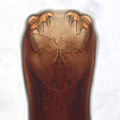 Anterior end of Ancylostoma caninum
 -
 Canine hookworm egg
 -
 Hookworms
 -
 Ancylostoma caninum


Ancylostoma caninum[edit]
Ancylostoma caninum is a species of hookworm that primarily infects dogs, but can also affect other mammals, including humans. It is a parasitic nematode that resides in the small intestine of its host, where it attaches to the intestinal wall and feeds on blood, leading to anemia and other health issues.
Life Cycle[edit]
The life cycle of Ancylostoma caninum involves several stages:
- Eggs: The adult female hookworm lays eggs in the host's intestine, which are then excreted in the feces.
- Larvae: The eggs hatch in the environment, releasing larvae. These larvae undergo several molts, developing into infective third-stage larvae.
- Infection: The infective larvae can penetrate the skin of a new host or be ingested. Once inside the host, they migrate to the lungs, are coughed up, swallowed, and eventually reach the small intestine.
- Maturation: In the small intestine, the larvae mature into adult worms, completing the cycle.
Pathogenesis[edit]
Ancylostoma caninum causes hookworm disease in dogs, characterized by symptoms such as diarrhea, weight loss, and lethargy. The worms attach to the intestinal mucosa, causing blood loss and leading to iron deficiency anemia. In severe cases, especially in puppies, the infection can be fatal.
Zoonotic Potential[edit]
Ancylostoma caninum is of zoonotic concern, meaning it can infect humans. The larvae can penetrate human skin, causing a condition known as cutaneous larva migrans, characterized by itchy, serpiginous tracks on the skin. Although the larvae do not mature into adult worms in humans, the condition can be uncomfortable and requires medical attention.
Diagnosis[edit]
Diagnosis of Ancylostoma caninum infection is typically made through fecal examination to identify hookworm eggs. In some cases, blood tests may be used to assess the severity of anemia and other related conditions.
Treatment and Control[edit]
Treatment of Ancylostoma caninum infection in dogs involves the use of anthelmintic medications, such as pyrantel pamoate, fenbendazole, or ivermectin. Preventive measures include regular deworming, maintaining good hygiene, and controlling environmental contamination to reduce the risk of infection.
Related Pages[edit]
| Parasitic diseases | ||||||||
|---|---|---|---|---|---|---|---|---|
This parasitic disease-related article is a stub.
|
| Veterinary medicine | ||||||||||
|---|---|---|---|---|---|---|---|---|---|---|
|
