Amylopectin: Difference between revisions
CSV import Tags: mobile edit mobile web edit |
CSV import |
||
| Line 6: | Line 6: | ||
File:Anton_van_Leeuwenhoek.png|Anton van Leeuwenhoek | File:Anton_van_Leeuwenhoek.png|Anton van Leeuwenhoek | ||
</gallery> | </gallery> | ||
==Amylopectin== | |||
'''Amylopectin''' is a highly branched polysaccharide and a major component of [[starch]], which is found in plants. It is one of the two components of starch, the other being [[amylose]]. Amylopectin is important in the storage of energy in plants and plays a significant role in human nutrition. | |||
==Structure== | |||
Amylopectin is composed of [[glucose]] units linked together primarily by _(1_4) glycosidic bonds, with branching occurring through _(1_6) glycosidic bonds approximately every 24 to 30 glucose units. This highly branched structure distinguishes amylopectin from amylose, which is mostly linear. The branching in amylopectin allows for rapid mobilization of glucose units when energy is needed. | |||
==Function== | |||
In plants, amylopectin is stored in [[chloroplasts]] and [[amyloplasts]] as part of starch granules. It serves as an energy reserve that can be broken down into glucose units when the plant requires energy. In humans, amylopectin is digested by [[amylase]] enzymes in the [[saliva]] and [[pancreas]], which break down the _(1_4) and _(1_6) bonds to release glucose. | |||
==Digestion and Metabolism== | |||
The digestion of amylopectin begins in the mouth with the enzyme salivary amylase, which hydrolyzes the _(1_4) bonds. The process continues in the [[small intestine]] with pancreatic amylase, which further breaks down the polysaccharide into [[maltose]] and [[dextrins]]. These are then converted into glucose by other enzymes such as [[maltase]] and [[isomaltase]]. The glucose is absorbed into the bloodstream and used by the body for energy. | |||
==Comparison with Amylose== | |||
Amylopectin and amylose are both components of starch, but they differ in structure and properties. Amylose is a linear polymer of glucose units connected by _(1_4) bonds, while amylopectin is branched. This structural difference affects their solubility and digestibility. Amylopectin is more soluble in water and is digested more rapidly than amylose, leading to a quicker rise in blood glucose levels. | |||
==Applications== | |||
Amylopectin is used in various industrial applications due to its thickening and stabilizing properties. It is commonly used in the food industry as a thickener in products such as sauces, soups, and gravies. It is also used in the production of [[biodegradable plastics]] and as a component in [[adhesives]]. | |||
==Related pages== | |||
* [[Starch]] | |||
* [[Amylose]] | |||
* [[Glucose]] | |||
* [[Glycogen]] | |||
* [[Carbohydrate]] | |||
{{Starch}} | |||
[[Category:Polysaccharides]] | |||
[[Category:Carbohydrates]] | |||
Latest revision as of 00:38, 19 February 2025
-
 Amylopectin molecular structure
 -
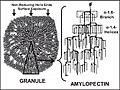 Amylopectin from starch granule
 -
 Amylopectin chains
 -
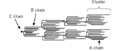 Cluster model of amylopectin structure
 -
 Anton van Leeuwenhoek


Amylopectin[edit]
Amylopectin is a highly branched polysaccharide and a major component of starch, which is found in plants. It is one of the two components of starch, the other being amylose. Amylopectin is important in the storage of energy in plants and plays a significant role in human nutrition.
Structure[edit]
Amylopectin is composed of glucose units linked together primarily by _(1_4) glycosidic bonds, with branching occurring through _(1_6) glycosidic bonds approximately every 24 to 30 glucose units. This highly branched structure distinguishes amylopectin from amylose, which is mostly linear. The branching in amylopectin allows for rapid mobilization of glucose units when energy is needed.
Function[edit]
In plants, amylopectin is stored in chloroplasts and amyloplasts as part of starch granules. It serves as an energy reserve that can be broken down into glucose units when the plant requires energy. In humans, amylopectin is digested by amylase enzymes in the saliva and pancreas, which break down the _(1_4) and _(1_6) bonds to release glucose.
Digestion and Metabolism[edit]
The digestion of amylopectin begins in the mouth with the enzyme salivary amylase, which hydrolyzes the _(1_4) bonds. The process continues in the small intestine with pancreatic amylase, which further breaks down the polysaccharide into maltose and dextrins. These are then converted into glucose by other enzymes such as maltase and isomaltase. The glucose is absorbed into the bloodstream and used by the body for energy.
Comparison with Amylose[edit]
Amylopectin and amylose are both components of starch, but they differ in structure and properties. Amylose is a linear polymer of glucose units connected by _(1_4) bonds, while amylopectin is branched. This structural difference affects their solubility and digestibility. Amylopectin is more soluble in water and is digested more rapidly than amylose, leading to a quicker rise in blood glucose levels.
Applications[edit]
Amylopectin is used in various industrial applications due to its thickening and stabilizing properties. It is commonly used in the food industry as a thickener in products such as sauces, soups, and gravies. It is also used in the production of biodegradable plastics and as a component in adhesives.
