Typha angustifolia: Difference between revisions
CSV import |
CSV import |
||
| Line 4: | Line 4: | ||
File:Typha_angustifolia_(habitus)_1.jpg|Typha angustifolia habitus | File:Typha_angustifolia_(habitus)_1.jpg|Typha angustifolia habitus | ||
</gallery> | </gallery> | ||
== Typha angustifolia == | |||
'''Typha angustifolia''', commonly known as '''narrowleaf cattail''', is a perennial herbaceous plant belonging to the family [[Typhaceae]]. It is widely distributed across the Northern Hemisphere, particularly in temperate and subtropical regions. This species is often found in wetlands, marshes, and along the edges of ponds and lakes. | |||
== Description == | |||
''Typha angustifolia'' is characterized by its tall, slender stems that can reach heights of 1.5 to 3 meters. The leaves are long, narrow, and linear, typically measuring 6 to 12 mm in width, which distinguishes it from other species such as [[Typha latifolia]], which has broader leaves. | |||
The plant produces distinctive cylindrical flower spikes, with the male flowers located above the female flowers on the same spike. The male flowers are yellowish and produce pollen, while the female flowers develop into dense, brown, sausage-shaped structures that persist through the winter. | |||
== Habitat and Distribution == | |||
''Typha angustifolia'' thrives in a variety of wetland habitats, including freshwater marshes, brackish marshes, and along the margins of lakes and rivers. It is tolerant of a range of water depths and can grow in both standing and slow-moving water. | |||
This species is native to Europe, Asia, and North America. It has been introduced to other regions, where it can become invasive, outcompeting native vegetation and altering wetland ecosystems. | |||
== Ecology == | |||
''Typha angustifolia'' plays a significant role in wetland ecosystems. It provides habitat and food for a variety of wildlife, including birds, insects, and aquatic organisms. The dense stands of cattails offer shelter and nesting sites for birds such as the [[red-winged blackbird]] and the [[marsh wren]]. | |||
The plant also contributes to the stabilization of wetland soils and the filtration of water, trapping sediments and absorbing nutrients. However, in some areas, its aggressive growth can lead to the displacement of native plant species and a reduction in biodiversity. | |||
== Uses == | |||
Historically, ''Typha angustifolia'' has been used by humans for various purposes. The leaves and stems have been used for weaving mats, baskets, and chair seats. The fluffy seed heads have been used as stuffing for pillows and mattresses. | |||
In some cultures, the young shoots and rhizomes are consumed as food. The pollen is also edible and can be used as a flour substitute. | |||
== Related Pages == | |||
* [[Typha latifolia]] | |||
* [[Wetland]] | |||
* [[Invasive species]] | |||
* [[Aquatic plant]] | |||
{{Taxonbar|from=Q157303}} | |||
[[Category:Typhaceae]] | |||
[[Category:Aquatic plants]] | |||
[[Category:Flora of Europe]] | |||
[[Category:Flora of Asia]] | |||
[[Category:Flora of North America]] | |||
Latest revision as of 00:38, 19 February 2025
Typha angustifolia[edit]
-
 Lesser Bulrush in Northumberland
 -
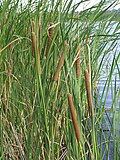 Typha angustifolia habitus

_1.jpg)
Typha angustifolia[edit]
Typha angustifolia, commonly known as narrowleaf cattail, is a perennial herbaceous plant belonging to the family Typhaceae. It is widely distributed across the Northern Hemisphere, particularly in temperate and subtropical regions. This species is often found in wetlands, marshes, and along the edges of ponds and lakes.
Description[edit]
Typha angustifolia is characterized by its tall, slender stems that can reach heights of 1.5 to 3 meters. The leaves are long, narrow, and linear, typically measuring 6 to 12 mm in width, which distinguishes it from other species such as Typha latifolia, which has broader leaves.
The plant produces distinctive cylindrical flower spikes, with the male flowers located above the female flowers on the same spike. The male flowers are yellowish and produce pollen, while the female flowers develop into dense, brown, sausage-shaped structures that persist through the winter.
Habitat and Distribution[edit]
Typha angustifolia thrives in a variety of wetland habitats, including freshwater marshes, brackish marshes, and along the margins of lakes and rivers. It is tolerant of a range of water depths and can grow in both standing and slow-moving water.
This species is native to Europe, Asia, and North America. It has been introduced to other regions, where it can become invasive, outcompeting native vegetation and altering wetland ecosystems.
Ecology[edit]
Typha angustifolia plays a significant role in wetland ecosystems. It provides habitat and food for a variety of wildlife, including birds, insects, and aquatic organisms. The dense stands of cattails offer shelter and nesting sites for birds such as the red-winged blackbird and the marsh wren.
The plant also contributes to the stabilization of wetland soils and the filtration of water, trapping sediments and absorbing nutrients. However, in some areas, its aggressive growth can lead to the displacement of native plant species and a reduction in biodiversity.
Uses[edit]
Historically, Typha angustifolia has been used by humans for various purposes. The leaves and stems have been used for weaving mats, baskets, and chair seats. The fluffy seed heads have been used as stuffing for pillows and mattresses.
In some cultures, the young shoots and rhizomes are consumed as food. The pollen is also edible and can be used as a flour substitute.
