Allis shad: Difference between revisions
CSV import |
CSV import |
||
| Line 4: | Line 4: | ||
File:Alosa-alosa.png|Allis shad | File:Alosa-alosa.png|Allis shad | ||
</gallery> | </gallery> | ||
==Allis Shad== | |||
The '''Allis shad''' (''Alosa alosa'') is a species of [[anadromous]] fish in the family [[Clupeidae]]. It is native to the eastern North Atlantic Ocean and the western Mediterranean Sea. The Allis shad is known for its migratory behavior, moving from marine to freshwater environments to spawn. | |||
==Description== | |||
The Allis shad is a medium-sized fish, typically reaching lengths of 30 to 60 centimeters. It has a laterally compressed body with a silvery sheen and a distinctive dark spot near the gill cover. The dorsal fin is short, and the tail fin is deeply forked. The scales are large and easily shed. | |||
==Distribution and Habitat== | |||
The Allis shad is found along the coasts of western Europe, from Norway to the Iberian Peninsula, and in the western Mediterranean Sea. It inhabits coastal waters and estuaries but migrates into rivers to spawn. The species prefers clean, fast-flowing rivers with gravelly or sandy substrates for spawning. | |||
==Life Cycle== | |||
Allis shad are anadromous, meaning they spend most of their lives in the sea but migrate to freshwater to spawn. Spawning occurs in spring and early summer. After hatching, the juvenile shad, known as fry, remain in freshwater for several months before migrating to the sea. They reach sexual maturity at around four to six years of age. | |||
==Diet== | |||
In the marine environment, Allis shad feed on [[plankton]], small fish, and crustaceans. During their time in freshwater, they do not feed, relying on stored energy reserves to sustain them through the spawning period. | |||
==Conservation Status== | |||
The Allis shad is considered a species of concern due to habitat loss, pollution, and barriers to migration such as dams and weirs. Conservation efforts focus on improving river habitats and removing obstacles to migration to support the recovery of shad populations. | |||
==Related Pages== | |||
* [[Twaite shad]] | |||
* [[Anadromous fish]] | |||
* [[Clupeidae]] | |||
{{Fish}} | |||
[[Category:Clupeidae]] | |||
[[Category:Anadromous fish]] | |||
[[Category:Fish of Europe]] | |||
Latest revision as of 00:38, 19 February 2025
-
 Allis shad
 -
 Allis shad
 -
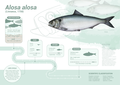 Allis shad


Allis Shad[edit]
The Allis shad (Alosa alosa) is a species of anadromous fish in the family Clupeidae. It is native to the eastern North Atlantic Ocean and the western Mediterranean Sea. The Allis shad is known for its migratory behavior, moving from marine to freshwater environments to spawn.
Description[edit]
The Allis shad is a medium-sized fish, typically reaching lengths of 30 to 60 centimeters. It has a laterally compressed body with a silvery sheen and a distinctive dark spot near the gill cover. The dorsal fin is short, and the tail fin is deeply forked. The scales are large and easily shed.
Distribution and Habitat[edit]
The Allis shad is found along the coasts of western Europe, from Norway to the Iberian Peninsula, and in the western Mediterranean Sea. It inhabits coastal waters and estuaries but migrates into rivers to spawn. The species prefers clean, fast-flowing rivers with gravelly or sandy substrates for spawning.
Life Cycle[edit]
Allis shad are anadromous, meaning they spend most of their lives in the sea but migrate to freshwater to spawn. Spawning occurs in spring and early summer. After hatching, the juvenile shad, known as fry, remain in freshwater for several months before migrating to the sea. They reach sexual maturity at around four to six years of age.
Diet[edit]
In the marine environment, Allis shad feed on plankton, small fish, and crustaceans. During their time in freshwater, they do not feed, relying on stored energy reserves to sustain them through the spawning period.
Conservation Status[edit]
The Allis shad is considered a species of concern due to habitat loss, pollution, and barriers to migration such as dams and weirs. Conservation efforts focus on improving river habitats and removing obstacles to migration to support the recovery of shad populations.
