Allium tricoccum: Difference between revisions
CSV import |
CSV import |
||
| Line 7: | Line 7: | ||
File:RampBunch.png|Bunch of ramps | File:RampBunch.png|Bunch of ramps | ||
</gallery> | </gallery> | ||
==Allium tricoccum== | |||
'''Allium tricoccum''', commonly known as '''ramps''', '''wild leeks''', or '''spring onions''', is a perennial plant native to the woodlands of eastern North America. It is a member of the [[Amaryllidaceae]] family, which also includes onions, garlic, and chives. | |||
==Description== | |||
Allium tricoccum is a herbaceous plant that grows from a small bulb. The plant typically emerges in early spring, with broad, smooth, light green leaves that are 10–15 cm long and 2–5 cm wide. The leaves have a distinctive garlic-like odor. By early summer, the leaves die back, and the plant produces a single flowering stalk, or scape, that can reach up to 50 cm in height. The scape bears a cluster of small, white flowers. | |||
==Habitat== | |||
Ramps are found in rich, moist, deciduous forests, often in shaded areas. They prefer well-drained, loamy soils and are commonly found in the understory of [[maple]], [[beech]], and [[oak]] forests. The plant is native to regions ranging from [[Quebec]] and [[Ontario]] in Canada, south to [[Georgia (U.S. state)|Georgia]] and [[Alabama]] in the United States. | |||
==Ecology== | |||
Allium tricoccum plays an important role in forest ecosystems. It is one of the first plants to emerge in the spring, providing an early source of food for wildlife. The plant is also a host for various insects and contributes to the biodiversity of forest floor communities. | |||
==Culinary Uses== | |||
Ramps are highly prized for their culinary uses. Both the leaves and bulbs are edible and have a strong, pungent flavor that is a cross between garlic and onion. They are often used in [[salads]], [[soups]], and [[pesto]], or simply sautéed as a side dish. Ramps are a traditional food in many Appalachian communities and are celebrated in festivals throughout the region. | |||
==Conservation== | |||
Due to their popularity and slow growth rate, ramps are susceptible to overharvesting. Sustainable harvesting practices are important to ensure the long-term survival of wild populations. This includes harvesting only a portion of the plants in a given area and leaving the bulbs in the ground to regenerate. | |||
==Related pages== | |||
* [[Allium]] | |||
* [[Amaryllidaceae]] | |||
* [[Perennial plant]] | |||
* [[Deciduous forest]] | |||
{{Taxonbar|from=Q157303}} | |||
[[Category:Allium]] | |||
[[Category:Flora of North America]] | |||
[[Category:Edible plants]] | |||
Latest revision as of 00:34, 19 February 2025
-
 Allium tricoccum in Vermont, USA
 -
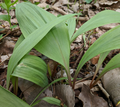 Allium tricoccum var. tricoccum
 -
 Allium burdickii
 -
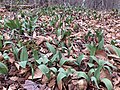 Ramps on forest floor
 -
 Wild leeks on Whitefish Island
 -
 Bunch of ramps


_1.JPG)

Allium tricoccum[edit]
Allium tricoccum, commonly known as ramps, wild leeks, or spring onions, is a perennial plant native to the woodlands of eastern North America. It is a member of the Amaryllidaceae family, which also includes onions, garlic, and chives.
Description[edit]
Allium tricoccum is a herbaceous plant that grows from a small bulb. The plant typically emerges in early spring, with broad, smooth, light green leaves that are 10–15 cm long and 2–5 cm wide. The leaves have a distinctive garlic-like odor. By early summer, the leaves die back, and the plant produces a single flowering stalk, or scape, that can reach up to 50 cm in height. The scape bears a cluster of small, white flowers.
Habitat[edit]
Ramps are found in rich, moist, deciduous forests, often in shaded areas. They prefer well-drained, loamy soils and are commonly found in the understory of maple, beech, and oak forests. The plant is native to regions ranging from Quebec and Ontario in Canada, south to Georgia and Alabama in the United States.
Ecology[edit]
Allium tricoccum plays an important role in forest ecosystems. It is one of the first plants to emerge in the spring, providing an early source of food for wildlife. The plant is also a host for various insects and contributes to the biodiversity of forest floor communities.
Culinary Uses[edit]
Ramps are highly prized for their culinary uses. Both the leaves and bulbs are edible and have a strong, pungent flavor that is a cross between garlic and onion. They are often used in salads, soups, and pesto, or simply sautéed as a side dish. Ramps are a traditional food in many Appalachian communities and are celebrated in festivals throughout the region.
Conservation[edit]
Due to their popularity and slow growth rate, ramps are susceptible to overharvesting. Sustainable harvesting practices are important to ensure the long-term survival of wild populations. This includes harvesting only a portion of the plants in a given area and leaving the bulbs in the ground to regenerate.
