Ainu cuisine: Difference between revisions
CSV import |
No edit summary |
||
| Line 1: | Line 1: | ||
{{Short description|An overview of the traditional cuisine of the Ainu people of Japan}} | {{Short description|An overview of the traditional cuisine of the Ainu people of Japan}} | ||
'''Ainu cuisine''' refers to the traditional food practices and dishes of the [[Ainu people]], the indigenous inhabitants of [[Hokkaido]], [[Sakhalin]], and the [[Kuril Islands]]. Ainu cuisine is distinct from the more widely known [[Japanese cuisine]] and reflects the Ainu's close relationship with nature and their reliance on the natural resources available in their environment. | '''Ainu cuisine''' refers to the traditional food practices and dishes of the [[Ainu people]], the indigenous inhabitants of [[Hokkaido]], [[Sakhalin]], and the [[Kuril Islands]]. Ainu cuisine is distinct from the more widely known [[Japanese cuisine]] and reflects the Ainu's close relationship with nature and their reliance on the natural resources available in their environment. | ||
| Line 35: | Line 33: | ||
==Modern Influence and Preservation== | ==Modern Influence and Preservation== | ||
Today, there is a growing interest in preserving and revitalizing Ainu culture, including its culinary traditions. Efforts are being made to document traditional recipes and promote Ainu cuisine to a wider audience. Some restaurants in Hokkaido now offer Ainu dishes, allowing both locals and tourists to experience this unique culinary heritage. | Today, there is a growing interest in preserving and revitalizing Ainu culture, including its culinary traditions. Efforts are being made to document traditional recipes and promote Ainu cuisine to a wider audience. Some restaurants in Hokkaido now offer Ainu dishes, allowing both locals and tourists to experience this unique culinary heritage. | ||
== Gallery == | |||
<gallery> | |||
File:Ainu_ohaw.jpg|Ainu cuisine | |||
File:C.n.yesoensis--modified.jpg|Ainu cuisine | |||
File:2005_RUSSIA_Ozernoy_Gulf_0121_small.jpg|Ainu cuisine | |||
File:Dolly_2.jpg|Ainu cuisine | |||
File:Allium_ochotense,_edible_wild_plants,_Hokkaido_Japan.jpg|Ainu cuisine | |||
File:Ainu_Set_Meal.jpg|Ainu cuisine | |||
File:Cipor_rataskep_チポㇿラタㇱケㇷ゚.jpg|Ainu cuisine | |||
File:Japan_Hokkaido_Ainu_traditional_house_”cise”3_2023.jpg|Ainu cuisine | |||
File:Saketoba.JPG|Ainu cuisine | |||
File:Cardiocrinum_cordatum_(bud).jpg|Ainu cuisine | |||
File:Munini-imo_Traditional_Ainu_potato_preserved_food.jpg|Ainu cuisine | |||
</gallery> | |||
==Related pages== | ==Related pages== | ||
Latest revision as of 20:16, 18 February 2025
An overview of the traditional cuisine of the Ainu people of Japan
Ainu cuisine refers to the traditional food practices and dishes of the Ainu people, the indigenous inhabitants of Hokkaido, Sakhalin, and the Kuril Islands. Ainu cuisine is distinct from the more widely known Japanese cuisine and reflects the Ainu's close relationship with nature and their reliance on the natural resources available in their environment.
Ingredients and Food Sources[edit]
Ainu cuisine is characterized by its use of natural ingredients sourced from the surrounding environment. The Ainu traditionally relied on hunting, fishing, and gathering to obtain their food.
Meat and Fish[edit]

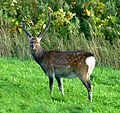
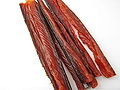
The Ainu diet includes a variety of meats and fish. Salmon is particularly important and is often prepared in various ways, such as drying or smoking. Other fish commonly consumed include trout and herring. The Ainu also hunt animals such as deer, bear, and rabbit, which are used in stews and other dishes.
Plants and Vegetables[edit]
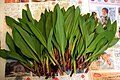
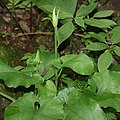
The Ainu gather a wide range of wild plants and vegetables. These include fuki (butterbur), udo (Aralia cordata), and various types of wild greens. These plants are often boiled or used in soups and stews.
Grains and Nuts[edit]
While the Ainu did not traditionally cultivate rice, they did use grains such as millet and barley. Nuts, such as walnuts and acorns, are also part of the Ainu diet and are often ground into flour or used as a thickening agent in soups.
Traditional Dishes[edit]
Ainu cuisine includes a variety of traditional dishes that reflect their unique culinary practices.
Ohaw[edit]
Ohaw is a traditional Ainu soup made with fish or meat and a variety of vegetables. It is seasoned with salt and sometimes flavored with miso or soy sauce.
Sito[edit]
Sito are dumplings made from millet or other grains. They are often served in soups or stews.
Chitatap[edit]
Chitatap is a dish made by finely chopping meat or fish with a knife. It is often mixed with wild vegetables and seasoned with salt.
Cultural Significance[edit]
Ainu cuisine is not only about sustenance but also holds cultural and spiritual significance. Many Ainu dishes are prepared and consumed during traditional ceremonies and festivals. The preparation and sharing of food are integral to Ainu social and cultural life.
Modern Influence and Preservation[edit]
Today, there is a growing interest in preserving and revitalizing Ainu culture, including its culinary traditions. Efforts are being made to document traditional recipes and promote Ainu cuisine to a wider audience. Some restaurants in Hokkaido now offer Ainu dishes, allowing both locals and tourists to experience this unique culinary heritage.
Gallery[edit]
-
 Ainu cuisine
 -
 Ainu cuisine
 -
 Ainu cuisine
 -
 Ainu cuisine
 -
 Ainu cuisine
 -
 Ainu cuisine
 -
 Ainu cuisine
 -
 Ainu cuisine
 -
 Ainu cuisine
 -
 Ainu cuisine
 -
 Ainu cuisine


.jpg)

