Arab culture: Difference between revisions
Created page with "'''Arab culture''' encompasses the customs, traditions, and social norms of the Arab world, which includes 22 countries in the Middle East and North Africa. This culture is ri..." |
CSV import |
||
| Line 49: | Line 49: | ||
[[Category:Arab culture]] | [[Category:Arab culture]] | ||
<gallery> | |||
File:Moorish_women_making_Arab_carpets,_Algiers,_Algeria-LCCN2001697844.jpg|Arab culture | |||
File:Antarah_ibn_Shaddad_&_Abla.jpg|Arab culture | |||
File:Aziz_Pasha_Abaza_عزيز_باشا_أباظة.jpg|Arab culture | |||
File:Arabischer_Maler_um_730_002.jpg|Arab culture | |||
File:Qānūn_-_MET_89.4.330.jpg|Arab culture | |||
File:Arabiya_Reporter.jpg|Arab culture | |||
File:Amr_Elleithy.png|Arab culture | |||
File:Jordan_Center_for_Defending_Freedom_of_Journalists_sign.JPG|Arab culture | |||
File:Mervat_Amin_1972.jpg|Arab culture | |||
File:Salah_Zulfikar_2.jpg|Arab culture | |||
File:Faten_Hamama_1962.jpg|Arab culture | |||
File:Cairo_Cafe.JPG|Arab culture | |||
</gallery> | |||
Latest revision as of 12:25, 18 February 2025
Arab culture encompasses the customs, traditions, and social norms of the Arab world, which includes 22 countries in the Middle East and North Africa. This culture is rich and diverse, influenced by a long history and a variety of ethnic groups, languages, and religions.
Language[edit]
The primary language of Arab culture is Arabic, which is spoken by over 400 million people. Arabic is a Semitic language and has many dialects, including Egyptian Arabic, Levantine Arabic, and Gulf Arabic. Classical Arabic is used in religious contexts and is the language of the Quran.
Religion[edit]
Islam is the predominant religion in the Arab world, and it plays a significant role in shaping cultural practices and values. Other religions, such as Christianity and Judaism, are also present in the region.
Art and Architecture[edit]
Arab culture is renowned for its contributions to art and architecture. Islamic art is characterized by intricate geometric patterns, calligraphy, and arabesques. Notable architectural achievements include the Alhambra in Spain and the Great Mosque of Mecca.
Literature[edit]
Arab literature has a rich tradition, with famous works such as "One Thousand and One Nights" and the poetry of Antarah ibn Shaddad. Modern Arab literature continues to thrive, with authors like Naguib Mahfouz and Adonis.
Music[edit]
Music is an integral part of Arab culture, with traditional instruments like the oud, qanun, and darbuka. Arab music has influenced many other musical traditions around the world.
Cuisine[edit]
Arab cuisine is diverse, with dishes like hummus, falafel, and shawarma being popular worldwide. The use of spices, herbs, and olive oil is common in Arab cooking.
Social Structure[edit]
Family is a central element of Arab culture, with extended families often living together. Hospitality is highly valued, and guests are treated with great respect and generosity.
Festivals[edit]
Arab culture celebrates various festivals, including Eid al-Fitr and Eid al-Adha, which are important religious holidays. Other cultural festivals highlight music, dance, and traditional crafts.
Related Pages[edit]
Gallery[edit]
-
 Moorish women making Arab carpets, Algiers, Algeria
 -
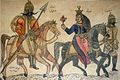 Antarah ibn Shaddad & Abla
 -
 Arab painter, circa 730
 -
 Arabiya Reporter
 -
 Amr Elleithy
 -
 Jordan Center for Defending Freedom of Journalists
 -
 Mervat Amin, 1972
 -
 Salah Zulfikar
 -
 Faten Hamama, 1962
 -
 Cairo Cafe
 -
 Crowd in Cairo Stadium
 -
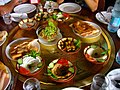 Petra metzes
 -
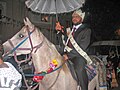 Jissr groom


-
Arab culture
-
Arab culture
-
 Arab culture
 -
Arab culture
-
 Arab culture
 -
Arab culture
-
Arab culture
-
Arab culture
-
Arab culture
-
Arab culture
-
Arab culture
-
Arab culture


