Perissodactyla: Difference between revisions
CSV import |
CSV import Tags: mobile edit mobile web edit |
||
| Line 37: | Line 37: | ||
{{stub}} | {{stub}} | ||
{{dictionary-stub1}} | {{dictionary-stub1}} | ||
<gallery> | |||
File:The_Perissodactyl.jpg|Perissodactyla | |||
File:Rhinoceros_male_2003.jpg|Rhinoceros male | |||
File:Anatomy_of_the_horses_foot.jpg|Anatomy of the horse's foot | |||
File:Hamburg_zoo_tapir.JPG|Tapir at Hamburg Zoo | |||
File:Indian_Rhino_001.jpg|Indian Rhino | |||
File:Tapirbaby.jpg|Tapir baby | |||
File:Paleotherium_magnum.jpg|Paleotherium magnum | |||
File:ChalicotheriumDB1.jpg|Chalicotherium | |||
File:Paraceratherium-Scale-Diagram-SVG-Steveoc86.svg|Paraceratherium scale diagram | |||
File:Hyracotherium_Eohippus_hharder.jpg|Hyracotherium (Eohippus) | |||
File:Richard_Owen_1856.jpg|Richard Owen, 1856 | |||
File:Equus_quagga_quagga,_coloured.jpg|Equus quagga quagga, coloured | |||
</gallery> | |||
Latest revision as of 12:22, 18 February 2025
Perissodactyla is an order of mammals, also known as odd-toed ungulates. This group includes three extant families: Equidae (horses), Rhinocerotidae (rhinoceroses), and Tapiridae (tapirs). The term "Perissodactyla" is derived from the Ancient Greek words "perissós" (odd) and "dáktylos" (finger/toe), referring to the uneven number of toes on the rear feet of animals in this group.
Characteristics[edit]
Members of the order Perissodactyla are characterized by an odd number of toes, with the third digit being the largest and bearing the weight of the body. They have simple stomachs and are hindgut fermenters, meaning they digest plant material in the large intestine. They also have a unique dental structure, with a gap (diastema) between the front teeth (incisors and canines) and the back teeth (molars).
Evolution[edit]
The Perissodactyla order is believed to have evolved during the late Paleocene, around 60 million years ago. The earliest known perissodactyl, Hyracotherium, was a small forest-dwelling creature. Over time, perissodactyls have evolved to adapt to various environments, from forests to grasslands.
Families[edit]
Equidae[edit]
The Equidae family includes horses, donkeys, and zebras. These animals are known for their speed and endurance, which they use to escape predators on the open plains.
Rhinocerotidae[edit]
The Rhinocerotidae family includes the five species of rhinoceros. These large, heavy animals are known for their thick skin and large horns.
Tapiridae[edit]
The Tapiridae family includes the four species of tapir. These animals are characterized by their short, prehensile snout.
Conservation[edit]
Many species within the Perissodactyla order are threatened or endangered due to habitat loss and hunting. Conservation efforts are ongoing to protect these unique animals.
See also[edit]
 | |
|---|---|
 |
 |
-
 Perissodactyla
 -
 Rhinoceros male
 -
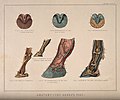 Anatomy of the horse's foot
 -
 Tapir at Hamburg Zoo
 -
 Indian Rhino
 -
 Tapir baby
 -
 Paleotherium magnum
 -
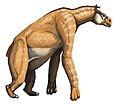 Chalicotherium
 -
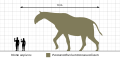 Paraceratherium scale diagram
 -
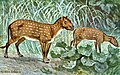 Hyracotherium (Eohippus)
 -
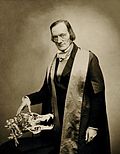 Richard Owen, 1856
 -
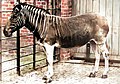 Equus quagga quagga, coloured


