Deconstructivism: Difference between revisions
CSV import Tags: mobile edit mobile web edit |
CSV import |
||
| Line 26: | Line 26: | ||
{{architecture-stub}} | {{architecture-stub}} | ||
<gallery> | |||
File:Image-Disney_Concert_Hall_by_Carol_Highsmith_edit-2.jpg|Deconstructivism | |||
File:Olivetti-Valentine.jpg|Deconstructivism | |||
File:Wotrubakirche2_Wien.JPG|Deconstructivism | |||
File:Seattle_Central_Library,_Seattle,_Washington_-_20060418.jpg|Deconstructivism | |||
File:ImperialWarMuseumNorth01.jpg|Deconstructivism | |||
File:A611,_8_Spruce_Street,_Manhattan,_July_2019.png|Deconstructivism | |||
File:JewishMuseumBerlin.jpg|Deconstructivism | |||
File:Bodenlos.jpg|Deconstructivism | |||
File:Steinhaus_Steindorf.jpg|Deconstructivism | |||
File:Vitra002a.jpg|Deconstructivism | |||
File:Prag_ginger_u_fred_gehry.jpg|Deconstructivism | |||
File:Capital-city-towers-moscow-indexxrus.JPG|Deconstructivism | |||
</gallery> | |||
Revision as of 12:22, 18 February 2025
Deconstructivism is a development in architecture that emerged in the late 20th century. It is characterized by ideas of fragmentation, an interest in manipulating ideas of a structure's surface or skin, non-rectilinear shapes, and the appearance of controlled chaos.
Origins
Deconstructivism's development is somewhat linked to the postmodern movement, yet its stark departure from the norms of architecture place it in its own category. The term "Deconstructivism" was first used in 1988 at the Museum of Modern Art's exhibition, "Deconstructivist Architecture". The exhibition showcased works by seven architects, including Frank Gehry, Zaha Hadid, and Daniel Libeskind. The term was coined by the exhibition's curator, Philip Johnson, and architectural critic, Mark Wigley.
Characteristics
Deconstructivism is often associated with a certain level of discomfort, as it challenges traditional architectural aesthetics. It is characterized by non-linear shapes and fragmented forms, which give the impression of dislocation and instability. This is achieved through techniques such as topology and tectonics, which manipulate the surface or skin of a structure.
Notable Works
Some of the most notable works of Deconstructivism include the Guggenheim Museum Bilbao by Frank Gehry, the Imperial War Museum North by Daniel Libeskind, and the Phaeno Science Center by Zaha Hadid. These structures exemplify the principles of Deconstructivism, with their fragmented forms, non-rectilinear shapes, and manipulation of the structure's surface.
Criticism
Deconstructivism has been criticized for its perceived lack of social responsibility, as it often prioritizes form over function. Critics argue that the style can be alienating and disorienting, and that it often disregards the needs of the building's users.
See Also
References
<references />
This article is a architecture-related stub. You can help WikiMD by expanding it!
-
 Deconstructivism
 -
 Deconstructivism
 -
 Deconstructivism
 -
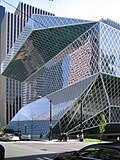 Deconstructivism
 -
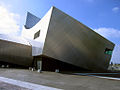 Deconstructivism
 -
 Deconstructivism
 -
 Deconstructivism
 -
 Deconstructivism
 -
 Deconstructivism
 -
Deconstructivism
-
Deconstructivism
-
Deconstructivism


