Tribulus terrestris: Difference between revisions
CSV import |
CSV import |
||
| Line 46: | Line 46: | ||
[[Category:Flora of Europe]] | [[Category:Flora of Europe]] | ||
[[Category:Flora of Australia]] | [[Category:Flora of Australia]] | ||
<gallery> | |||
File:Tribulus_terrestris_(Family_Zygophyllaceae).jpg|Tribulus terrestris plant | |||
File:Tribulus_terrestris_growing_on_a_beach_(Philippines)_1.jpg|Tribulus terrestris growing on a beach in the Philippines | |||
File:Starr_030612-0067_Tribulus_terrestris.jpg|Tribulus terrestris | |||
File:Tribulus_Terrestris_Germinating.jpg|Tribulus terrestris germinating | |||
File:Gokhru_(Pakhra).JPG|Gokhru (Pakhra) | |||
File:Trte_003_lhp.jpg|Tribulus terrestris | |||
File:Tribulus_terrestris_nutlets_in_foot,_Marfa,_Texas.JPG|Tribulus terrestris nutlets in foot, Marfa, Texas | |||
File:Starr_030612-0070_Tribulus_terrestris.jpg|Tribulus terrestris | |||
</gallery> | |||
Latest revision as of 12:21, 18 February 2025
Tribulus terrestris[edit]
.jpg)
_1.jpg)
Tribulus terrestris is a species of plant in the family Zygophyllaceae, native to warm temperate and tropical regions of the Old World in southern Europe, southern Asia, throughout Africa, and Australia. It is commonly known as puncture vine, caltrop, or goat's-head.
Description[edit]
Tribulus terrestris is a prostrate, mat-forming plant that grows to about 10 cm in height. The leaves are pinnate, with leaflets that are oblong and opposite. The flowers are small, yellow, and have five petals. The fruit is a woody burr with sharp spines, which can puncture bicycle tires and cause injury to animals and humans.
Habitat and Distribution[edit]
This plant thrives in dry, sandy soils and is often found in disturbed areas such as roadsides, fields, and waste places. It is considered a weed in many regions due to its invasive nature and ability to spread rapidly.
Uses[edit]
Tribulus terrestris has been used in traditional medicine for various purposes, including as an aphrodisiac and to treat kidney stones. It is also marketed as a dietary supplement for enhancing athletic performance, although scientific evidence supporting these claims is limited.
Ecological Impact[edit]
The plant's spiny fruit can cause significant ecological and economic damage. It can injure livestock and wildlife, and its ability to spread quickly makes it a problematic invasive species in many areas.
Related pages[edit]
References[edit]
<references group="" responsive="1"></references>
External links[edit]
- Tribulus terrestris at the National Invasive Species Information Center


.JPG)


-
 Tribulus terrestris plant
 -
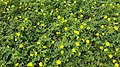 Tribulus terrestris growing on a beach in the Philippines
 -
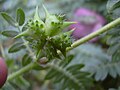 Tribulus terrestris
 -
 Tribulus terrestris germinating
 -
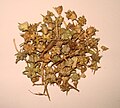 Gokhru (Pakhra)
 -
 Tribulus terrestris
 -
 Tribulus terrestris nutlets in foot, Marfa, Texas
 -
 Tribulus terrestris
