Oriental melon: Difference between revisions
CSV import |
CSV import |
||
| Line 23: | Line 23: | ||
[[Category:Cucurbitaceae]] | [[Category:Cucurbitaceae]] | ||
{{food-stub}} | {{food-stub}} | ||
<gallery> | |||
File:Korean_melon1.jpg|Oriental melon | |||
File:Chamoe-jangajji.jpg|Oriental melon | |||
File:Growing_Korean_melons_1_Seeds.jpg|Oriental melon | |||
File:Growing_Korean_melons_4_Seedlings.jpg|Oriental melon | |||
File:Growing_Korean_melons_5_Young_plants.jpg|Oriental melon | |||
File:Cucumis_melo_var._makuwa_01.jpg|Oriental melon | |||
File:Korean_melons_1.jpg|Oriental melon | |||
File:Cucumis_melo_var._makuwa_02.jpg|Oriental melon | |||
File:Cucumis_melo_var._makuwa_03.jpg|Oriental melon | |||
File:Korean_melon1.jpg|Oriental melon | |||
File:Korean_melon_transverse.jpg|Oriental melon | |||
File:Korean_melon_longitudinal.jpg|Oriental melon | |||
</gallery> | |||
Revision as of 12:20, 18 February 2025
Oriental Melon (Cucumis melo Makuwa Group), also known as the Korean melon, is a type of melon primarily grown in East Asia. Despite its name, the Oriental melon is not limited to the Orient or Asia, as it is also cultivated in different parts of the world.
Description
The Oriental melon is a small, oblong fruit that typically measures between 4 to 8 inches in length. It has a bright yellow outer skin and a white, crisp inner flesh. The flavor of the Oriental melon is subtly sweet, with a high water content, making it a refreshing fruit especially during the summer months.
Cultivation
Oriental melons prefer a warm, temperate climate, similar to that of their native East Asia. They are typically planted in the spring and harvested in the summer. The melons grow on vines and require a well-drained soil rich in organic matter.
Uses
Oriental melons are often eaten fresh, as a dessert or a snack. They can also be used in salads, smoothies, and desserts. In Korea, they are commonly used in a traditional dish called Melona, a melon-flavored ice pop.
Nutritional Value
Oriental melons are low in calories and high in vitamins A and C. They also contain a good amount of potassium and dietary fiber.
See Also

-
 Oriental melon
 -
 Oriental melon
 -
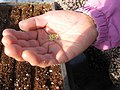 Oriental melon
 -
 Oriental melon
 -
 Oriental melon
 -
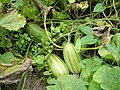 Oriental melon
 -
 Oriental melon
 -
 Oriental melon
 -
 Oriental melon
 -
Oriental melon
-
 Oriental melon
 -
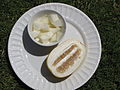 Oriental melon


