Ipomoea aquatica: Difference between revisions
CSV import |
CSV import |
||
| Line 28: | Line 28: | ||
[[Category:Invasive plant species in the United States]] | [[Category:Invasive plant species in the United States]] | ||
{{food-stub}} | {{food-stub}} | ||
<gallery> | |||
File:Chha_trokoun.jpg|Ipomoea aquatica | |||
File:N_Ipoa_D1600.JPG|Ipomoea aquatica | |||
File:空心菜_-_深圳.jpg|Ipomoea aquatica | |||
File:Adobong_kangkong_(Philippines).jpg|Ipomoea aquatica | |||
File:Ensaladang_kangkong.jpg|Ipomoea aquatica | |||
File:Pelecing_kangkung.JPG|Ipomoea aquatica | |||
File:Mie_Kangkung.JPG|Ipomoea aquatica | |||
File:Gendar_Petis_Kangkung.jpg|Ipomoea aquatica | |||
File:Kangkungblacan.jpg|Ipomoea aquatica | |||
File:Pak_boong_fai_daeng.jpg|Ipomoea aquatica | |||
File:Canhchua2.jpg|Ipomoea aquatica | |||
File:Ipomoea_aquatica_(Marsh_Glory)_flower_W2_IMG_0405.jpg|Ipomoea aquatica | |||
</gallery> | |||
Revision as of 12:19, 18 February 2025
Ipomoea aquatica is a semi-aquatic, tropical plant grown as a vegetable for its tender shoots and leaves. It is found throughout the tropical and subtropical regions of the world, although it is not known where it originated. This plant is known by many common names, including water spinach, river spinach, water morning glory, water convolvulus, or by more ambiguous names such as Chinese spinach, swamp cabbage or kangkong in Southeast Asia.
Description
Ipomoea aquatica is a fast-growing, aquatic or semi-aquatic, perennial plant native to South and Southeast Asia. The leaves vary from typically sagittate (arrow head shaped) to lanceolate, 5–15 cm long and 2–8 cm broad. The flowers are trumpet-shaped, 3–5 cm in diameter, and usually white in colour with a mauve centre.
Cultivation and uses
Ipomoea aquatica is most commonly grown in East, South and Southeast Asia. It flourishes naturally in waterways and requires little if any care. It is used extensively in Malaysian cuisine, particularly in Malay and Peranakan dishes.
In Vietnamese cuisine, it is commonly cooked in soups and stir-fried dishes. In Thai cuisine, it is also commonly used to make a variety of dishes, most notably the spicy and sour soup, kaeng som.
Nutritional value
Ipomoea aquatica has a high concentration of vitamins and minerals. It has been found to be particularly rich in vitamin A, vitamin C, and iron. It is also a good source of dietary fiber, potassium, and magnesium.
Invasive species
In some regions, Ipomoea aquatica is regarded as an invasive species. It has become a significant environmental weed in many areas of the United States, particularly in Florida and Texas.
See also
References
<references />

-
Ipomoea aquatica
-
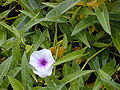 Ipomoea aquatica
 -
 Ipomoea aquatica
 -
 Ipomoea aquatica
 -
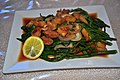 Ipomoea aquatica
 -
 Ipomoea aquatica
 -
 Ipomoea aquatica
 -
 Ipomoea aquatica
 -
 Ipomoea aquatica
 -
 Ipomoea aquatica
 -
 Ipomoea aquatica
 -
 Ipomoea aquatica


.jpg)


_flower_W2_IMG_0405.jpg)

