Spider anatomy: Difference between revisions
CSV import |
CSV import |
||
| Line 66: | Line 66: | ||
[[Category:Spider anatomy]] | [[Category:Spider anatomy]] | ||
{{Arachnology-stub}} | {{Arachnology-stub}} | ||
<gallery> | |||
File:Spider-characteristics.png|Spider characteristics | |||
File:Brown_widow_spider_Latrodectus_geometricus_underside.jpg|Brown widow spider underside | |||
File:Spider_external_anatomy_en.png|Spider external anatomy | |||
File:Jumping_Spider_Eyes.jpg|Jumping spider eyes | |||
File:Pfurtscheller_Table_25.png|Pfurtscheller Table 25 | |||
File:Spider_internal_anatomy-en.svg|Spider internal anatomy | |||
File:Comstock-book-lungs.png|Comstock book lungs | |||
File:OrbWheever-Georgia-Woods.png|Orb weaver in Georgia woods | |||
</gallery> | |||
Revision as of 12:19, 18 February 2025
Spider Anatomy refers to the physical structure and biological systems of spiders, a group of arachnids that includes over 48,000 described species.
External Anatomy
The external anatomy of spiders is characterized by two main body parts: the cephalothorax (also known as the prosoma) and the abdomen (also known as the opisthosoma).
Cephalothorax
The cephalothorax is the front part of a spider's body, and it is a fusion of the head and thorax. It houses the spider's eyes, chelicerae (fangs), pedipalps, and the first four pairs of legs.
Eyes
Most spiders have eight simple eyes, although some species may have six or fewer. The arrangement and size of these eyes can be used to help identify the species of spider.
Chelicerae and Fangs
The chelicerae are the mouthparts of the spider, which end in fangs. These fangs are used to inject venom into prey from glands that are located near the chelicerae.
Pedipalps
Pedipalps are appendages located near the mouth of the spider. In males, they are used for reproduction and are modified to transfer sperm to the female during mating.
Legs
Spiders have four pairs of legs, which are attached to the cephalothorax. Each leg is divided into seven parts, and the end of each leg has two or three small claws.
Abdomen
The abdomen is the rear part of a spider's body. It contains the spider's reproductive organs, spinnerets, and the heart.
Spinnerets
Spinnerets are small, movable appendages located at the end of the abdomen. They are used to produce silk, which is used for various purposes such as creating webs, lining burrows, and wrapping prey.
Internal Anatomy
The internal anatomy of spiders includes the digestive system, the respiratory system, the circulatory system, and the nervous system.
Digestive System
The digestive system of a spider includes a mouth, a stomach, and intestines. Spiders liquefy their prey with digestive juices and then suck up the resulting fluid.
Respiratory System
Spiders have two types of respiratory systems: book lungs and tracheae. Some spiders have both types, while others have one or the other.
Circulatory System
Spiders have an open circulatory system, with a heart, arteries, and hemolymph (the spider equivalent of blood).
Nervous System
The nervous system of a spider includes a brain, a subesophageal ganglion, and a ventral nerve cord.
Reproduction
Spider reproduction typically involves the transfer of sperm from the male to the female through the male's modified pedipalps. The female then lays eggs and wraps them in silk to protect them.
See Also
This article is a Arachnology-related stub. You can help WikiMD by expanding it!
-
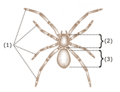 Spider characteristics
 -
 Brown widow spider underside
 -
 Spider external anatomy
 -
 Jumping spider eyes
 -
 Pfurtscheller Table 25
 -
 Spider internal anatomy
 -
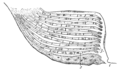 Comstock book lungs
 -
 Orb weaver in Georgia woods


