Phenoxy herbicide: Difference between revisions
CSV import |
CSV import |
||
| Line 24: | Line 24: | ||
{{DEFAULTSORT:Phenoxy Herbicide}} | {{DEFAULTSORT:Phenoxy Herbicide}} | ||
<gallery> | |||
File:Phenoxyacetic-acid.png|Phenoxyacetic acid | |||
File:Indol-3-ylacetic_acid.svg|Indol-3-ylacetic acid | |||
File:2-(4-chloro-2-methylphenoxy)acetic_acid_200.svg|2-(4-chloro-2-methylphenoxy)acetic acid | |||
File:2-(2,4-dichlorophenoxy)acetic_acid_200.svg|2-(2,4-dichlorophenoxy)acetic acid | |||
File:2-(2,4,5-trichlorophenoxy)acetic_acid_200.svg|2-(2,4,5-trichlorophenoxy)acetic acid | |||
File:Mecoprop_structure.png|Mecoprop structure | |||
File:Dichlorprop.svg|Dichlorprop | |||
File:Fenoprop.png|Fenoprop | |||
File:4-(2,4-dichlorophenoxy)butanoic_acid_200.svg|4-(2,4-dichlorophenoxy)butanoic acid | |||
File:MCPB.png|MCPB | |||
File:2,4-D_usage_USA.png|2,4-D usage in USA | |||
File:Aryloxyphenoxypropionate.svg|Aryloxyphenoxypropionate | |||
</gallery> | |||
Revision as of 12:18, 18 February 2025
Phenoxy herbicides are a family of chemicals commonly used in agriculture and landscaping for the control of broadleaf weeds. They are known for their ability to selectively kill certain plants without harming grasses and other desired crops. This class of herbicides works by mimicking the action of the plant hormone auxin, leading to uncontrolled growth and eventually the death of the targeted plants.
Chemistry and Mode of Action
Phenoxy herbicides are characterized by their phenoxyacetic acid structure. The most well-known chemicals in this group include 2,4-D (2,4-dichlorophenoxyacetic acid), MCPA (2-methyl-4-chlorophenoxyacetic acid), and 2,4,5-T (2,4,5-trichlorophenoxyacetic acid). These compounds act as synthetic auxins, a type of plant hormone that regulates growth. When applied in high concentrations, phenoxy herbicides cause the plant cells to grow at an unsustainable rate, leading to tissue damage and plant death.
Usage
Phenoxy herbicides have been widely used since their development in the 1940s. They are applied in agricultural settings to control broadleaf weeds in cereal crops, pastures, and turf. These herbicides are also used in non-crop areas such as roadsides, industrial sites, and residential lawns for weed control.
Environmental and Health Concerns
The use of phenoxy herbicides has raised environmental and health concerns. One of the most controversial compounds, 2,4,5-T, was a component of Agent Orange, a defoliant used during the Vietnam War. The production of 2,4,5-T can lead to the formation of Dioxins, highly toxic compounds that persist in the environment and can cause cancer, reproductive and developmental problems, and damage to the immune system.
Due to these concerns, the use of 2,4,5-T has been banned or restricted in many countries. However, other phenoxy herbicides like 2,4-D are still in use, although their safety continues to be the subject of research and regulatory review.
Regulation
The regulation of phenoxy herbicides varies by country, with some nations imposing strict controls or outright bans on certain compounds. In the United States, the Environmental Protection Agency (EPA) regulates the use of these chemicals, setting limits on their application and residue levels in food. The European Union also has stringent regulations in place, focusing on minimizing the environmental impact and ensuring the safety of food products.
Conclusion
Phenoxy herbicides have played a significant role in agricultural weed control, contributing to increased crop yields and efficiency. However, their environmental and health impacts have led to controversy and regulatory scrutiny. Ongoing research and development efforts aim to produce safer and more effective herbicidal compounds, reducing the reliance on chemicals with known adverse effects.

-
 Phenoxyacetic acid
 -
 Indol-3-ylacetic acid
 -
 2-(4-chloro-2-methylphenoxy)acetic acid
 -
 2-(2,4-dichlorophenoxy)acetic acid
 -
 2-(2,4,5-trichlorophenoxy)acetic acid
 -
 Mecoprop structure
 -
 Dichlorprop
 -
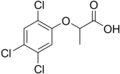 Fenoprop
 -
 4-(2,4-dichlorophenoxy)butanoic acid
 -
 MCPB
MCPB -
 2,4-D usage in USA
 -
 Aryloxyphenoxypropionate


acetic_acid_200.svg)
acetic_acid_200.svg)
acetic_acid_200.svg)


butanoic_acid_200.svg)


