Peak District: Difference between revisions
No edit summary |
CSV import Tags: mobile edit mobile web edit |
||
| Line 20: | Line 20: | ||
[[Category:Tourist attractions in England]] | [[Category:Tourist attractions in England]] | ||
{{UK-geo-stub}} | {{UK-geo-stub}} | ||
<gallery> | |||
File:Peak_District_National_Park_UK_location_map.svg|Peak District | |||
File:Near_the_High_Peak_-_pano.jpg|Near the High Peak | |||
File:Towns_of_the_Peak_District.png|Towns of the Peak District | |||
File:Rivers_of_the_Peak_District.svg|Rivers of the Peak District | |||
File:Bugsworth_058079.jpg|Bugsworth | |||
File:Thor's_cave.jpg|Thor's Cave | |||
File:Kinder_plateau.jpg|Kinder Plateau | |||
File:Tunstead_Quarry_-_geograph.org.uk_-_865006.jpg|Tunstead Quarry | |||
File:Buxtoncres1.jpg|Buxton Crescent | |||
File:Welldressing_Hayfield.jpg|Well Dressing in Hayfield | |||
File:Mamtor-paragliding.jpg|Mam Tor Paragliding | |||
File:The_Roaches_and_Hen_Cloud.jpg|The Roaches and Hen Cloud | |||
</gallery> | |||
Latest revision as of 12:15, 18 February 2025
Peak District is a region in England known for its captivating landscapes, rich history, and diverse wildlife. It is the oldest of the 15 national parks in the United Kingdom, having been designated in 1951.
Geography[edit]
The Peak District is located in the central and northern parts of England, spanning areas of Derbyshire, Cheshire, Greater Manchester, Staffordshire, and South Yorkshire. It is characterized by rolling hills, deep valleys, and vast moorlands. The park is divided into two main areas: the Dark Peak, where you can find gritstone 'edges' and moorland fields, and the White Peak, known for its limestone valleys and rare alabaster formations.
History[edit]
The history of the Peak District dates back to the Mesolithic era, with archaeological evidence of human activity from as early as 10,000 BC. The region was later inhabited by the Celts, Romans, and Anglo-Saxons, each leaving their mark on the landscape and culture. The Peak District's rich industrial history is evident in the many historic mills, mines, and canals that can be found throughout the park.
Flora and Fauna[edit]
The Peak District is home to a wide variety of flora and fauna. The moorlands are a habitat for species such as the Red Grouse and Mountain Hare, while the limestone dales host a range of rare wildflowers and insects. The park is also home to several species of bats, including the Lesser Horseshoe Bat and the Daubenton's Bat.
Tourism[edit]
Tourism is a significant part of the Peak District's economy, with millions of visitors each year. The park offers a range of outdoor activities, including hiking, cycling, and rock climbing. There are also numerous cultural and historical sites to explore, such as Chatsworth House, Haddon Hall, and the Castleton Caves.
Conservation[edit]
Conservation efforts in the Peak District are managed by the Peak District National Park Authority. These efforts include protecting the park's unique landscapes and biodiversity, preserving its cultural heritage, and promoting sustainable tourism.
-
 Peak District
 -
 Near the High Peak
 -
 Towns of the Peak District
 -
 Rivers of the Peak District
 -
 Bugsworth
 -
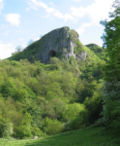 Thor's Cave
 -
Kinder Plateau
-
Tunstead Quarry
-
Buxton Crescent
-
Well Dressing in Hayfield
-
Mam Tor Paragliding
-
The Roaches and Hen Cloud


