Malva sylvestris: Difference between revisions
CSV import |
CSV import |
||
| Line 23: | Line 23: | ||
{{Flora-stub}} | {{Flora-stub}} | ||
{{Medicine-stub}} | {{Medicine-stub}} | ||
<gallery> | |||
File:Mallow_January_2008-1.jpg|Malva sylvestris | |||
File:Malva_sylvestris_(1).jpg|Malva sylvestris | |||
File:MalopeTrifida1.jpg|Malva sylvestris | |||
File:Maria's_Blue_Eyes_01.jpg|Malva sylvestris | |||
File:Malva_sylvestris_-_Köhler–s_Medizinal-Pflanzen-222.jpg|Malva sylvestris | |||
File:Malva_sylvestris_in_Antalya_by_David_Merrick_26.jpg|Malva sylvestris | |||
File:Malva_sylvestris_in_Antalya_by_David_Merrick_03.jpg|Malva sylvestris | |||
File:Malva_sylvestris_in_Antalya_by_David_Merrick_02.jpg|Malva sylvestris | |||
File:Malva_sylvestris_in_Edinburgh_by_David_Merrick_22.jpg|Malva sylvestris | |||
File:Malva_sylvestris_in_Antalya_by_David_Merrick_15.jpg|Malva sylvestris | |||
File:Malva_sylvestris_in_Antalya_by_David_Merrick_17.jpg|Malva sylvestris | |||
File:Malva_sylvestris_in_Antalya_by_David_Merrick_25.jpg|Malva sylvestris | |||
</gallery> | |||
Latest revision as of 12:15, 18 February 2025
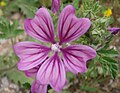
Malva sylvestris is a species of the mallow genus Malva in the family of Malvaceae and is considered to be the type species for the genus. Known as common mallow to English-speaking Europeans, it acquired the common names of cheeses, high mallow and tall mallow (mauve des bois by the French) as it migrated from its native home in Western Europe, North Africa and Asia through the English-speaking world.
Description[edit]
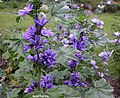
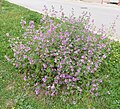
Malva sylvestris is a spreading herb, which is an annual in North Africa, biennial in the Mediterranean and a perennial elsewhere. Three feet (one meter) tall, (3 meters has been observed in a wild or escaped from cultivation setting, and in a garden setting 6 feet (2 meters) is common) with a growth habit which can be straight or decumbent, branched and covered with fine soft hairs or none at all, Malva sylvestris is pleasing in appearance when it first starts to flower, but as the summer advances, "the leaves lose their deep green color and the stems assume a ragged appearance".
Distribution[edit]
Malva sylvestris spreads itself on waste and rough ground, by roads and railways throughout lowland England, Wales and Channel Islands, Siberia and scattered elsewhere. It has been introduced to and has become naturalised in eastern Australia, in the United States, Canada and Mexico probably escaped from cultivation.
Uses[edit]
Malva sylvestris has been used medicinally since ancient times, and is still used in modern herbalism. Mucilage is present in many of the Malvaceae family including M. sylvestris, especially the fruit. The seeds are used internally in a decoction or herbal tea as a demulcent, and the leaves made into poultices as an emollient for external applications.
Cultivation[edit]
Malva sylvestris is often grown as an ornamental plant for its attractive flowers, produced for a long period through the summer. Numerous cultivars have been selected and named.
See also[edit]

This flora-related article is a stub. You can help WikiMD by expanding it.

-
 Malva sylvestris
 -
 Malva sylvestris
 -
 Malva sylvestris
 -
 Malva sylvestris
 -
 Malva sylvestris
 -
 Malva sylvestris
 -
 Malva sylvestris
 -
 Malva sylvestris
 -
 Malva sylvestris
 -
 Malva sylvestris
 -
 Malva sylvestris
 -
 Malva sylvestris

.jpg)


