East Germany: Difference between revisions
CSV import |
CSV import |
||
| Line 34: | Line 34: | ||
[[Category:East Germany]] | [[Category:East Germany]] | ||
{{stub}} | {{stub}} | ||
<gallery> | |||
File:Europe-GDR_(orthographic_projection).svg|East Germany | |||
File:East_Germany_1956-1990.svg|East Germany | |||
File:Soviet_Sector_Germany.png|East Germany | |||
File:Deutschland_Bundeslaender_1949.png|East Germany | |||
File:West_and_East_Berlin.svg|East Germany | |||
File:Bundesarchiv_Bild_183-19000-3301,_Berlin,_DDR-Gründung,_Wahl_Pieck,_Grotewohl.jpg|East Germany | |||
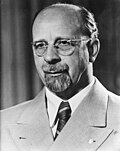
File:Opvolger_van_Pieck,_Walter_Ulbricht,_Bestanddeelnr_911-5926_(cropped).jpg|East Germany | |||
File:Bundesarchiv_Bild_183-R1220-401,_Erich_Honecker_(cropped).jpg|East Germany | |||
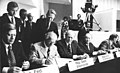
File:Bundesarchiv_Bild_183-P0801-026,_Helsinki,_KSZE-Konferenz,_Schlussakte.jpg|East Germany | |||
File:Karl_Marx_memorial.jpg|East Germany | |||
File:Bundesarchiv_Bild_183-1982-0816-002,_Leipzig,_Karl-Marx-Platz,_Brunnen.jpg|East Germany | |||
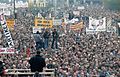
File:Bundesarchiv_Bild_183-1989-1104-437,_Berlin,_Demonstration_am_4._November.jpg|East Germany | |||
</gallery> | |||
== East Germany == | |||
<gallery> | <gallery> | ||
File:Europe-GDR_(orthographic_projection).svg|East Germany | File:Europe-GDR_(orthographic_projection).svg|East Germany | ||
Revision as of 12:15, 18 February 2025
East Germany, officially known as the German Democratic Republic (GDR), was a country that existed from 1949 to 1990. It was established in the Soviet zone of occupation in Germany after World War II and was the socialist state of the Eastern Bloc.
History
The history of East Germany started with the end of World War II when the Soviet Union occupied the eastern part of Germany. The Potsdam Agreement established the legal framework for the occupation. The Soviet Union and the Western Allies set up the east and west German states in 1949. The Cold War began, and the two German states became symbols of the divided world.
Politics
East Germany was a socialist state. The country was governed by the Socialist Unity Party of Germany (SED), which was formed in 1946 by the merger of the Communist Party of Germany and the Social Democratic Party of Germany. The SED held the power in the country until the Peaceful Revolution in 1989.
Economy
The economy of East Germany was centrally planned, and increasingly state-owned. Prices of housing, basic goods, and services were set by central government planners, rather than rising and falling through supply and demand. Although the GDR had to pay substantial war reparations to the USSR, it became the most successful economy in the Eastern Bloc.
Society
The society of East Germany was heavily influenced by the ideology of the ruling Socialist Unity Party. Education, the arts, and the media were tightly controlled by the state. The Stasi, the East German state security service, was one of the most effective and repressive intelligence and secret police agencies in the world.
Dissolution
The fall of the Berlin Wall in 1989 marked the beginning of the end for East Germany. The Peaceful Revolution, a series of protests by East Germans, led to the GDR's first free elections in March 1990, and to the negotiations between the GDR and FRG that culminated in a Unification Treaty.
See also
References
<references />
External links
- DDR-Wissen (in German)
 | |
|---|---|
 |
 |
-
 East Germany
 -
 East Germany
 -
 East Germany
 -
 East Germany
 -
 East Germany
 -
 East Germany
 -
 East Germany
 -
 East Germany
 -
 East Germany
 -
 East Germany
 -
 East Germany
 -
 East Germany
.svg)


.jpg)
.jpg)


East Germany
-
East Germany
-
East Germany
-
East Germany
-
East Germany
-
East Germany
-
East Germany
-
East Germany
-
East Germany
-
East Germany
-
East Germany
-
East Germany
-
East Germany
