Veliger: Difference between revisions
CSV import Tags: mobile edit mobile web edit |
CSV import |
||
| Line 44: | Line 44: | ||
[[Category:Mollusc larval stages]] | [[Category:Mollusc larval stages]] | ||
<gallery> | |||
File:9d_old_veliger_larva_of_the_nudibranch_Tritonia_diomedea.jpg|Veliger | |||
File:Dolabrifera5.jpg|Veliger | |||
File:Fiona_pinnata_veliger_8.png|Veliger | |||
File:Fiona_pinnata_veliger_7.png|Veliger | |||
File:Fiona_pinnata_veliger_6.png|Veliger | |||
File:Fiona_pinnata_veliger_5.png|Veliger | |||
File:Fiona_pinnata_veliger_4.png|Veliger | |||
File:Fiona_pinnata_veliger_3.png|Veliger | |||
File:Fiona_pinnata_veliger.png|Veliger | |||
File:Fiona_pinnata_veliger_2.png|Veliger | |||
</gallery> | |||
Revision as of 12:13, 18 February 2025
Larval stage of certain mollusks
The veliger is a larval stage in the development of certain mollusks, including gastropods and bivalves. This stage follows the trochophore stage and is characterized by the development of a ciliated structure known as the velum, which is used for swimming and feeding.
Development
The veliger stage is a critical phase in the life cycle of mollusks. During this stage, the larvae undergo significant morphological changes. The velum, a large ciliated lobe, is used for locomotion and feeding. The veliger also begins to develop the shell and other adult structures.
Shell Formation
In the veliger stage, the initial formation of the shell occurs. This process is crucial for the protection and structural support of the developing mollusk. The shell begins as a simple structure and gradually becomes more complex as the veliger matures.
Metamorphosis
The transition from the veliger stage to the juvenile stage involves metamorphosis. During this process, the velum is resorbed, and the organism settles to the substrate, where it continues its development into an adult.
Ecological Role
Veligers play a significant role in the marine ecosystem. As planktonic organisms, they are an essential part of the food web, serving as prey for a variety of marine animals. Their distribution and abundance can influence the population dynamics of adult mollusks.
Research and Study
The study of veligers provides insights into the developmental biology of mollusks. Researchers often use veligers to understand the effects of environmental changes on marine life, as they are sensitive indicators of water quality and ecosystem health.
Related pages
References
- Barnes, R.D. (1987). Invertebrate Zoology. Philadelphia, PA: Saunders College Publishing.
- Ruppert, E.E., Fox, R.S., & Barnes, R.D. (2004). Invertebrate Zoology: A Functional Evolutionary Approach. Belmont, CA: Brooks/Cole.
Gallery
-
 9-day-old veliger larva of the nudibranch Tritonia diomedea
 -
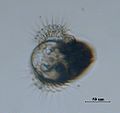 Veliger of Dolabrifera
 -
 Fiona pinnata veliger
 -
 Fiona pinnata veliger
 -
 Fiona pinnata veliger
 -
 Fiona pinnata veliger
 -
 Fiona pinnata veliger
 -
 Fiona pinnata veliger
 -
 Fiona pinnata veliger
 -
 Fiona pinnata veliger


-
Veliger
-
Veliger
-
Veliger
-
Veliger
-
Veliger
-
Veliger
-
Veliger
-
Veliger
-
Veliger
-
Veliger
