Insect ecology: Difference between revisions
CSV import Tags: mobile edit mobile web edit |
CSV import Tags: mobile edit mobile web edit |
||
| Line 29: | Line 29: | ||
[[Category:Insect Ecology]] | [[Category:Insect Ecology]] | ||
[[Category:Environmental Science]] | [[Category:Environmental Science]] | ||
<gallery> | |||
File:Beetle_larva_(Lethocerus_patruelis)_attacking_fish_(Pseudorasbora_parva)_-_ZooKeys-319-119-s001.ogv|Beetle larva (Lethocerus patruelis) attacking fish (Pseudorasbora parva) | |||
File:Scarabaeus_laticollis_2.jpg|Scarabaeus laticollis | |||
File:Predator_vs_Predator_(33971673831).jpg|Predator vs Predator | |||
File:Tiny_fly_carrying_parasite._-_Flickr_-_gailhampshire.jpg|Tiny fly carrying parasite | |||
File:Wasp_and_spider_02.jpg|Wasp and spider | |||
File:Phytophagous_beetle_(lat.oxythyrea_funesta).jpg|Phytophagous beetle (Oxythyrea funesta) | |||
File:Pollination.gif|Pollination | |||
File:Nicrophorus_humator_-_sexton_beetle_-_Flickr_-_Nick_Goodrum_Photography.jpg|Nicrophorus humator - sexton beetle | |||
</gallery> | |||
Latest revision as of 12:11, 18 February 2025
Insect Ecology refers to the scientific study of how insects interact with their environment, other species, and each other. It encompasses various aspects of their life cycles, behaviors, roles in ecosystems, and responses to environmental changes. Insects, being the most diverse group of organisms on Earth, play critical roles in ecosystems, including pollination, decomposition, and as a part of the food web. Understanding insect ecology is crucial for conservation efforts, pest management, and predicting the impacts of environmental changes on biodiversity.
Overview[edit]
Insect ecology is a branch of ecology that focuses on the study of insects and their relationships with the environment. It covers a wide range of topics, from the individual and population level to the community and ecosystem level. Insects interact with their environment in complex ways, serving as pollinators, predators, prey, and decomposers. They are influenced by various biotic and abiotic factors, including temperature, humidity, food availability, and interactions with other organisms.
Key Concepts[edit]
Pollination[edit]
Pollination is a critical ecological service provided by many insects, such as bees, butterflies, and moths. These insects transfer pollen from one flower to another, facilitating plant reproduction. This interaction is vital for the production of fruits, vegetables, and seeds, supporting both natural ecosystems and human agriculture.
Decomposition[edit]
Insects also play a crucial role in decomposition, breaking down dead plant and animal matter. This process recycles nutrients back into the ecosystem, promoting soil health and fertility. Decomposers like beetles and fly larvae are essential for maintaining the balance of nutrients in ecosystems.
Food Web[edit]
Insects are a fundamental part of the food web, serving as a primary food source for many animals, including birds, bats, and amphibians. The presence and abundance of insects can significantly influence predator-prey dynamics within ecosystems.
Pest Management[edit]
Understanding insect ecology is essential for effective pest management. By studying the life cycles, behaviors, and interactions of pest species, scientists can develop more sustainable and environmentally friendly control methods. This includes biological control, where natural predators or parasites of the pest species are introduced to reduce their numbers.
Conservation[edit]
Insect populations are declining globally due to habitat loss, pollution, climate change, and other human activities. Conserving insect diversity is crucial for maintaining ecosystem services, such as pollination and decomposition. Conservation efforts focus on protecting habitats, reducing pesticide use, and restoring ecosystems.
Challenges and Future Directions[edit]
One of the major challenges in insect ecology is understanding the impacts of climate change on insect populations and distributions. As temperatures rise and weather patterns change, insects may migrate to new areas, potentially disrupting existing ecosystems. Researchers are also exploring the role of insects in sustainable agriculture and how they can be used to improve crop production while reducing environmental impacts.
Conclusion[edit]
Insect ecology is a vital field of study that sheds light on the complex interactions between insects and their environment. By understanding these relationships, we can better appreciate the importance of insects in ecosystems, address challenges in conservation and pest management, and predict the impacts of environmental changes on biodiversity.
-
 Beetle larva (Lethocerus patruelis) attacking fish (Pseudorasbora parva)
 -
 Scarabaeus laticollis
 -
 Predator vs Predator
 -
 Tiny fly carrying parasite
 -
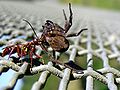 Wasp and spider
 -
 Phytophagous beetle (Oxythyrea funesta)
 -
 Pollination
 -
 Nicrophorus humator - sexton beetle

.jpg)


.jpg)


