Xining: Difference between revisions
CSV import |
CSV import Tags: mobile edit mobile web edit |
||
| Line 46: | Line 46: | ||
[[Category:Silk Road]] | [[Category:Silk Road]] | ||
[[Category:Populated places on the Yellow River]] | [[Category:Populated places on the Yellow River]] | ||
<gallery> | |||
File:Skyscrapers_in_Chengzhong_District,_Xining_(53727167629)_-_2024.jpg|Xining | |||
File:Qinghai.Xining.Batiment_de_jade.Résidence.Ma_Bufang.jpg|Xining | |||
File:Xining_-_53725921152.jpg|Xining | |||
File:Kumbum_Monastery.jpg|Xining | |||
File:China_May_2007_231.jpg|Xining | |||
File:Nanliang_Hutai_Relics_Park,_Xining_(20230927094732).jpg|Xining | |||
File:Xining_skyline.jpg|Xining | |||
File:Plateau_Pearl_Sightseeing_Tower_-_Xining.jpg|Xining | |||
File:塔尔寺02.jpg|Xining | |||
File:Dongguan_mosque_Xining.jpg|Xining | |||
File:Street_of_Xining.jpg|Xining | |||
File:Xining_railway_station_indoors.jpg|Xining | |||
</gallery> | |||
Latest revision as of 12:07, 18 February 2025
Xining
Xining is the capital city of Qinghai province in western China. It is a significant cultural, economic, and political center in the region, known for its diverse population and rich history. Xining serves as a gateway to the Tibetan Plateau and is an important hub for travelers exploring the region.
History[edit]
Xining has a long and storied history, dating back over 2,100 years. It was historically a part of the Silk Road, serving as a crucial link between China and the western regions. The city has been influenced by various cultures, including Han Chinese, Tibetan, Mongolian, and Hui Muslim communities.
During the Tang Dynasty, Xining was known as "Qingtang City" and was a vital military outpost. In the Ming Dynasty, it became a center for trade and commerce. The city's strategic location has made it a focal point for cultural exchange and economic development throughout history.
Geography[edit]
Xining is situated on the eastern edge of the Tibetan Plateau, at an elevation of approximately 2,275 meters (7,464 feet) above sea level. The city is surrounded by mountains and is located near the Huangshui River, a tributary of the Yellow River.
The climate in Xining is classified as a cold semi-arid climate, with long, cold winters and short, mild summers. The city experiences significant temperature variations between day and night due to its high altitude.
Demographics[edit]
Xining is home to a diverse population, with a mix of ethnic groups including Han Chinese, Tibetans, Hui Muslims, Mongols, and Tu people. This diversity is reflected in the city's cultural practices, festivals, and cuisine.
The city has a population of over 2 million people, making it the largest city in Qinghai province. The presence of multiple ethnic groups contributes to a rich cultural tapestry, with various languages, religions, and traditions coexisting in the city.
Economy[edit]
Xining is an economic hub in Qinghai province, with industries ranging from agriculture and animal husbandry to mining and manufacturing. The city is known for its production of wool, leather, and textiles, as well as its role in the extraction of natural resources such as coal and salt.
In recent years, Xining has seen growth in sectors such as tourism, renewable energy, and technology. The city's strategic location and transportation infrastructure make it an important center for trade and logistics in western China.
Culture[edit]
Xining is a cultural melting pot, with influences from Tibetan, Muslim, and Han Chinese traditions. The city hosts several important cultural and religious sites, including the Kumbum Monastery, one of the most important Tibetan Buddhist monasteries outside of Tibet.
The city is also known for its vibrant festivals, such as the Qinghai Lake International Poetry Festival and the Xining International Film Festival. These events attract visitors from around the world and showcase the city's cultural diversity.
Transportation[edit]
Xining is well-connected by road, rail, and air. The Xining Caojiabao International Airport provides flights to major cities in China and some international destinations. The city is also a key stop on the Qinghai-Tibet Railway, which connects Xining to Lhasa in Tibet.
The city's public transportation system includes buses and taxis, making it easy for residents and visitors to navigate the city.
Also see[edit]
| County-level divisions of Qinghai Province | ||||
|---|---|---|---|---|
* 1 These are administrative zones, which are not standard units of local government, though they do function as such.
|
-
 Xining
 -
 Xining
 -
 Xining
 -
 Xining
 -
 Xining
 -
 Xining
 -
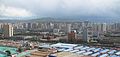 Xining
 -
 Xining
 -
 Xining
 -
 Xining
 -
 Xining
 -
 Xining
_-_2024.jpg)


.jpg)


