Early modern human: Difference between revisions
CSV import Tags: mobile edit mobile web edit |
CSV import |
||
| Line 35: | Line 35: | ||
{{stub}} | {{stub}} | ||
== Early modern human == | |||
<gallery> | |||
File:Homo_sapiens_sapiens_(Fundort_Jebel_Irhoud_Marokko).jpg|Homo sapiens sapiens (Jebel Irhoud, Morocco) | |||
File:Skhul.JPG|Skhul fossil | |||
File:Ksar_Akil_Fossils.jpg|Ksar Akil fossils | |||
File:Anatomically_Modern_Humans_archaeological_remains,_Europe_and_Africa,_directly_dated,_calibrated_carbon_dates_as_of_2013.jpg|Anatomically Modern Humans archaeological remains, Europe and Africa | |||
File:Sapiens_neanderthal_comparison_en.png|Comparison of Homo sapiens and Neanderthals | |||
File:Em_-_Homo_sapiens_man_model_-_3.jpg|Homo sapiens man model | |||
File:Lithic_Industries_at_Blombos_Cave,_Southern_Cape,_South_Africa_(c._105_–_90_Ka).jpg|Lithic Industries at Blombos Cave, Southern Cape, South Africa | |||
File:Blombos_point_white.JPG|Blombos point | |||
File:Claimed_Oldest_Known_Drawing_by_Human_Hands_Discovered_in_South_African_Cave.jpg|Claimed Oldest Known Drawing by Human Hands Discovered in South African Cave | |||
</gallery> | |||
Latest revision as of 12:06, 18 February 2025
Early Modern Human
The Early Modern Human or EMH is a stage in the evolution of Homo sapiens, the species to which modern humans belong. The EMH stage is thought to have begun around 350,000 to 260,000 years ago, and is associated with the earliest known records of modern human-like cranial anatomy, such as the Omo-Kibish I and Herto Man, and the earliest known records of modern human behavior, such as symbolic behavior and complex tools.
Etymology[edit]
The term "Early Modern Human" is used to distinguish this stage in human evolution from the Anatomically Modern Human (AMH) stage, which began around 200,000 years ago. The term "modern" in "Early Modern Human" refers to the species Homo sapiens, as opposed to earlier species in the genus Homo, such as Homo neanderthalensis and Homo erectus.
Anatomy and Behavior[edit]
Early Modern Humans had a cranial capacity similar to that of modern humans, but their cranial shape was more elongated than that of modern humans. They also had a more robust postcranial skeleton, which is thought to reflect a lifestyle that included a high degree of physical activity.
The behavior of Early Modern Humans is thought to have been more complex than that of earlier human species. This is evidenced by the presence of symbolic behavior, such as the use of ochre and other pigments, and the production of complex tools, such as projectile points and levallois flakes.
Related Terms[edit]
- Anatomically Modern Human
- Homo neanderthalensis
- Homo erectus
- Omo-Kibish I
- Herto Man
- Ochre
- Projectile points
- Levallois flakes
See Also[edit]
 | |
|---|---|
 |
 |
Early modern human[edit]
-
 Homo sapiens sapiens (Jebel Irhoud, Morocco)
 -
 Skhul fossil
 -
 Ksar Akil fossils
 -
 Anatomically Modern Humans archaeological remains, Europe and Africa
 -
 Comparison of Homo sapiens and Neanderthals
 -
 Homo sapiens man model
 -
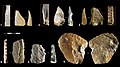 Lithic Industries at Blombos Cave, Southern Cape, South Africa
 -
 Blombos point
 -
 Claimed Oldest Known Drawing by Human Hands Discovered in South African Cave
.jpg)


.jpg)


