Starfish regeneration: Difference between revisions
CSV import |
CSV import |
||
| Line 27: | Line 27: | ||
[[Category:Regeneration (biology)]] | [[Category:Regeneration (biology)]] | ||
{{biology-stub}} | {{biology-stub}} | ||
== Starfish_regeneration == | |||
<gallery> | |||
File:Asterias_rubens.jpg|Common starfish, Asterias rubens | |||
File:Simple_Sea_Star_Body_Plan.png|Simple sea star body plan | |||
File:Starfish_Unidirectional_Regen.png|Starfish unidirectional regeneration | |||
File:Disk-Dependent_Bidirectional_Regeneration.png|Disk-dependent bidirectional regeneration | |||
File:Disk-Independent_Bidirectional_Regeneration.png|Disk-independent bidirectional regeneration | |||
File:Sea_star_regenerating_legs.jpg|Sea star regenerating legs | |||
File:Reef0206.jpg|Starfish_regeneration | |||
File:Autotomy.png|Autotomy in starfish | |||
File:Fission.png|Fission in starfish | |||
</gallery> | |||
Latest revision as of 12:05, 18 February 2025
Starfish Regeneration
Starfish, or sea stars, are marine invertebrates belonging to the class Asteroidea. They are known for their remarkable ability to regenerate lost body parts, a process that has fascinated scientists and laypeople alike. This article delves into the mechanisms, extent, and implications of starfish regeneration.
Overview[edit]
Starfish regeneration refers to the process by which these creatures can regrow lost arms and, in some cases, entire bodies from a single arm. This ability varies among different species of starfish, with some capable of regenerating more rapidly and completely than others.
Mechanism[edit]
The mechanism of starfish regeneration involves complex biological processes that begin at the cellular level. When a starfish loses an arm, cells near the wound site start to dedifferentiate, transforming into a type of cell that can proliferate and grow into different kinds of tissues. These cells, known as neoblasts, are akin to stem cells found in other animals. They divide and differentiate to form new tissues, including muscles, nerves, and skin, eventually regrowing the lost arm.
Genetic Factors[edit]
Recent studies have identified several genes and molecular pathways that play crucial roles in the regeneration process. These include genes involved in wound healing, cell proliferation, and differentiation. Understanding these genetic factors is crucial for unraveling the mysteries of regeneration and could have implications for regenerative medicine in humans.
Environmental Factors[edit]
Environmental conditions such as temperature, salinity, and the availability of food can influence the rate of starfish regeneration. Optimal conditions promote faster healing and growth, while adverse conditions can slow down or even halt the process.
Implications for Regenerative Medicine[edit]
The study of starfish regeneration has significant implications for regenerative medicine, a field that seeks to develop therapies for repairing or replacing damaged human tissues and organs. By understanding the mechanisms behind starfish regeneration, scientists hope to uncover new strategies for stimulating regeneration in humans, potentially leading to treatments for a wide range of injuries and diseases.
Conservation and Ecological Impact[edit]
Starfish play a crucial role in marine ecosystems, often serving as keystone species. Their ability to regenerate not only ensures their survival but also maintains the balance of marine habitats. However, this remarkable ability can also pose challenges for managing populations of invasive starfish species, such as the crown-of-thorns starfish, which can devastate coral reefs.
Conclusion[edit]
Starfish regeneration remains a fascinating area of study with far-reaching implications. As research continues to uncover the secrets of this remarkable process, it holds the promise of contributing to advances in medicine and providing insights into the conservation of marine ecosystems.

Starfish_regeneration[edit]
-
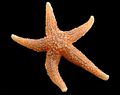 Common starfish, Asterias rubens
 -
 Simple sea star body plan
 -
 Starfish unidirectional regeneration
 -
 Disk-dependent bidirectional regeneration
 -
 Disk-independent bidirectional regeneration
 -
 Sea star regenerating legs
 -
 Starfish_regeneration
 -
 Autotomy in starfish
 -
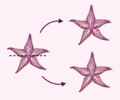 Fission in starfish


