Cockcroft–Walton generator: Difference between revisions
CSV import |
CSV import |
||
| Line 26: | Line 26: | ||
{{physics-stub}} | {{physics-stub}} | ||
<gallery> | |||
File:Cockcroft–Walton_generator_2012.JPG|Cockcroft–Walton generator 2012 | |||
File:KEK_Cockcroft-Walton_Accelerator_(1).jpg|KEK Cockcroft-Walton Accelerator | |||
File:Cockcroft_Walton_voltage_multiplier_circuit.svg|Cockcroft-Walton voltage multiplier circuit | |||
File:Full_wave_Cockcroft_Walton_Voltage_multiplier.png|Full wave Cockcroft-Walton Voltage multiplier | |||
File:Cockcroft-Walton_accelerator_Clarendon_Lab_Oxford.jpg|Cockcroft-Walton accelerator Clarendon Lab Oxford | |||
File:Cockcroft-Walton_3MV_Kaiser_Wilhelm_Institute_1937_top_view.png|Cockcroft-Walton 3MV Kaiser Wilhelm Institute 1937 top view | |||
File:Cockcroft-Walton_3MV_Kaiser_Wilhelm_Institute_1937.png|Cockcroft-Walton 3MV Kaiser Wilhelm Institute 1937 | |||
File:TV_cascade_and_flyback.JPG|Cockcroft–Walton generator | |||
</gallery> | |||
Latest revision as of 12:04, 18 February 2025
Cockcroft–Walton generator, also known as the Cockcroft–Walton voltage multiplier, is an electric circuit that generates a high voltage from a low-voltage source through the use of a series of capacitors and diodes. This device is named after the British and Irish physicists John Douglas Cockcroft and Ernest Thomas Sinton Walton, who invented the circuit in 1932 to power their experiments in nuclear physics. The Cockcroft–Walton generator is notable for its use in particle accelerators, X-ray machines, and in providing the high voltage for early models of television sets and Radar systems.
Design and Operation[edit]
The basic principle behind the Cockcroft–Walton generator is the use of a diode-capacitor network to successively multiply the input voltage in a step-up fashion. The circuit typically consists of a ladder network of capacitors and diodes that charge during the input voltage's positive cycle and discharge in series during the negative cycle, effectively increasing the voltage with each stage of the ladder.
The generator can be configured in either a half-wave or a full-wave rectification design, with the full-wave version providing a higher output voltage for the same number of stages due to its more efficient use of the input AC cycle.
Applications[edit]
Originally developed to provide the high voltage necessary for early nuclear physics experiments, including the first artificial nuclear reactions and the disintegration of the atomic nucleus, the Cockcroft–Walton generator has found a variety of applications over the years. Its ability to produce high voltages at relatively low currents makes it suitable for powering the electron guns in particle accelerators, X-ray tubes in medical imaging devices, and the ion pumps in mass spectrometers. Additionally, it has been used in the power supply for television sets and Radar systems before the advent of more compact and efficient technologies.
Advantages and Disadvantages[edit]
The main advantage of the Cockcroft–Walton generator is its simplicity and ability to achieve high voltages without the need for a transformer with a high turns ratio. This makes it relatively easy and inexpensive to build with standard components. However, the generator has several disadvantages, including a relatively low output current, the production of significant electrical noise, and a decrease in efficiency with each added stage due to the voltage drop across the diodes.
Modern Usage[edit]
While the advent of solid-state technology and other advancements have led to more efficient methods for generating high voltages, the Cockcroft–Walton generator still finds use in specific applications where its simplicity and the specific characteristics of its output are advantageous. It remains a popular choice for educational demonstrations and DIY projects due to its straightforward design and the ease with which it can be constructed from readily available components.
See Also[edit]

-
 Cockcroft–Walton generator 2012
 -
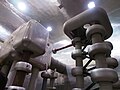 KEK Cockcroft-Walton Accelerator
 -
 Cockcroft-Walton voltage multiplier circuit
 -
 Full wave Cockcroft-Walton Voltage multiplier
 -
 Cockcroft-Walton accelerator Clarendon Lab Oxford
 -
 Cockcroft-Walton 3MV Kaiser Wilhelm Institute 1937 top view
 -
 Cockcroft-Walton 3MV Kaiser Wilhelm Institute 1937
 -
 Cockcroft–Walton generator

.jpg)


