African wild dog: Difference between revisions
CSV import |
CSV import |
||
| Line 47: | Line 47: | ||
[[Category:Mammals of Africa]] | [[Category:Mammals of Africa]] | ||
[[Category:Endangered species]] | [[Category:Endangered species]] | ||
<gallery> | |||
File:African_Wild_Dog_at_Working_with_Wildlife.jpg|African wild dog | |||
File:202104_Dog.svg|African wild dog | |||
File:Dogs,_jackals,_wolves,_and_foxes_(Plate_I).jpg|African wild dog | |||
File:Dogs,_jackals,_wolves,_and_foxes_(Plate_IX).jpg|African wild dog | |||
File:Dogs,_jackals,_wolves,_and_foxes_(Plate_XI).jpg|African wild dog | |||
File:Dogs,_jackals,_wolves,_and_foxes_(Plate_X).jpg|African wild dog | |||
File:Dogs,_jackals,_wolves,_and_foxes_(Plate_VI).jpg|African wild dog | |||
File:Dogs,_jackals,_wolves,_and_foxes_(Plate_XLI).jpg|African wild dog | |||
File:Dogs,_jackals,_wolves,_and_foxes_(Plate_XLIV).jpg|African wild dog | |||
File:Dogs,_jackals,_wolves,_and_foxes_(Plate_XIII).jpg|African wild dog | |||
File:Dogs,_jackals,_wolves,_and_foxes_(Plate_XII).jpg|African wild dog | |||
File:Bartolini-Lucenti,_S.,_Madurell-Malapeira,_J.,_Martínez-Navarro,_B._et_al._(2021)_fig._4_Xenocyon_lycaonoides.png|African wild dog | |||
</gallery> | |||
Revision as of 12:03, 18 February 2025
African Wild Dog
The African wild dog (Lycaon pictus), also known as the painted wolf or Cape hunting dog, is a canid native to sub-Saharan Africa. It is the largest indigenous canid in Africa and the only extant member of the genus Lycaon, which is distinguished from Canis by its fewer toes and dentition, highly specialized for a hypercarnivorous diet.
Description
The African wild dog is a highly social animal, living in packs with separate dominance hierarchies for males and females. The species is a cooperative hunter, with a diet consisting mainly of antelopes, which it catches by chasing them to exhaustion. The African wild dog is a diurnal hunter, which means it hunts during the day.
Habitat
African wild dogs are found in a variety of habitats, including savannas, grasslands, and open woodlands. They require large territories to support their hunting lifestyle, and their range can vary from 400 to 1,500 square kilometers.
Behavior
African wild dogs are known for their complex social structure and cooperative hunting techniques. Packs are usually composed of 2 to 27 individuals, but larger packs have been observed. The pack is led by a dominant breeding pair, and the entire pack takes part in the care of the young.
Reproduction
Breeding typically occurs during the rainy season, and after a gestation period of about 70 days, a litter of 2 to 20 pups is born. The pups are cared for by the entire pack, and they begin to hunt with the pack at around 3 months of age.
Conservation
The African wild dog is classified as Endangered by the IUCN, with a population estimated at fewer than 6,000 individuals. The primary threats to their survival include habitat fragmentation, human-wildlife conflict, and infectious diseases.
Related pages
Gallery
-
 African Wild Dog
 -
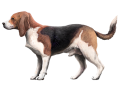 Illustration of African Wild Dog
 -
 Plate I
 -
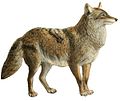 Plate IX
 -
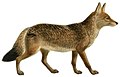 Plate XI
 -
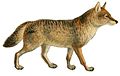 Plate X
 -
 Plate VI
 -
 Plate XLI
 -
 Plate XLIV
 -
 Plate XIII
 -
Plate XII


.jpg)
.jpg)
.jpg)
.jpg)
.jpg)
.jpg)
.jpg)
.jpg)
-
African wild dog
-
African wild dog
-
African wild dog
-
African wild dog
-
African wild dog
-
African wild dog
-
African wild dog
-
African wild dog
-
African wild dog
-
African wild dog
-
African wild dog
-
African wild dog

.jpg)
_fig._4_Xenocyon_lycaonoides.png)