Akan people: Difference between revisions
CSV import |
CSV import |
||
| Line 46: | Line 46: | ||
[[Category:Akan people]] | [[Category:Akan people]] | ||
<gallery> | |||
File:Akan_Gold_Weight_MHNT_bovid_head.jpg|Akan people | |||
File:Akan_face.jpg|Akan people | |||
File:Akan_dancer.jpg|Akan people | |||
File:Brooklyn_Museum_1993.182.3_Staff_Finial.jpg|Akan people | |||
File:Brooklyn_Museum_1998.36_Mask_Bo_Nun_Amuin.jpg|Akan people | |||
File:Brooklyn_Museum_22.1771_Elephant_Mask_GlaoKlolo_(3).jpg|Akan people | |||
File:COLLECTIE_TROPENMUSEUM_Houten_masker_van_een_woudgod_TMnr_3305-16.jpg|Akan people | |||
File:Gold_ornaments_(mask_and_shield),_Ashanti_-_African_objects_in_the_American_Museum_of_Natural_History_-_DSC05964.JPG|Akan people | |||
File:Ashantee_soldier2.jpg|Akan people | |||
File:Asante_map.jpg|Akan people | |||
File:African-civilizations-map-pre-colonial.svg|Akan people | |||
File:The_Mali_Empire.jpg|Akan people | |||
</gallery> | |||
Latest revision as of 12:03, 18 February 2025
Akan People
The Akan people are a group of culturally related ethnic groups residing primarily in Ghana and Ivory Coast in West Africa. They are known for their rich cultural heritage, including their art, music, and traditional beliefs.
History[edit]
The Akan people have a long history that dates back to the 11th century. They are believed to have migrated from the Sahel region to their current locations in West Africa. The Akan were instrumental in the development of several powerful states, including the Ashanti Empire and the Fante Confederacy.
Culture[edit]
The Akan culture is diverse and vibrant, with a strong emphasis on family and community. They are known for their elaborate festivals, traditional music, and dance. The Akan are also famous for their Akan gold weights, which were used as a form of currency and for measuring gold dust.
Art[edit]
Akan art is renowned for its beauty and symbolism. It includes a variety of forms such as sculpture, weaving, and pottery. Masks and gold ornaments are particularly significant in Akan art, often used in rituals and ceremonies.
Language[edit]
The Akan people speak several dialects of the Akan language, which is part of the Niger-Congo languages family. The most widely spoken dialects are Twi and Fante.
Society[edit]
Akan society is traditionally matrilineal, meaning that lineage and inheritance are traced through the mother's line. The Akan have a complex system of chieftaincy, with chiefs playing a central role in governance and community leadership.
Economy[edit]
Historically, the Akan economy was based on agriculture, trade, and gold mining. The region is rich in natural resources, particularly gold, which has been a major factor in the Akan's wealth and influence.
Religion[edit]
The Akan practice a traditional religion that includes belief in a supreme god, lesser deities, and ancestral spirits. Many Akan people also practice Christianity or Islam, often blending these with traditional beliefs.
Related pages[edit]
Gallery[edit]
-
 Akan gold weight
 -
 Akan face
 -
 Akan dancer
 -
 Staff finial
 -
 Mask Bo Nun Amuin
 -
 Elephant mask
 -
 Wooden mask of a forest god
 -
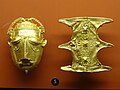 Gold ornaments
 -
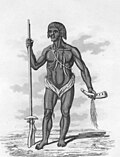 Ashantee soldier
 -
 Map of Asante
 -
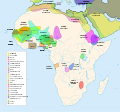 Map of African civilizations


.jpg)

,_Ashanti_-_African_objects_in_the_American_Museum_of_Natural_History_-_DSC05964.JPG)


-
Akan people
-
Akan people
-
Akan people
-
Akan people
-
Akan people
-
Akan people
-
Akan people
-
Akan people
-
Akan people
-
Akan people
-
Akan people
-
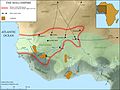 Akan people

