Wood-decay fungus: Difference between revisions
CSV import |
CSV import |
||
| Line 38: | Line 38: | ||
{{Wood-stub}} | {{Wood-stub}} | ||
{{Decomposition-stub}} | {{Decomposition-stub}} | ||
<gallery> | |||
File:Braunfaeule_Holz_FI20070208.jpg|Wood-decay fungus | |||
File:Fomes_fomentarius_(Zunderschwamm).jpg|Wood-decay fungus | |||
File:Dry_rot_and_water_damage.jpg|Wood-decay fungus | |||
File:Cubical_rot_checked_quercus_bialowieza_1_beentree.jpg|Wood-decay fungus | |||
File:Wood_decayed_Fungi.jpg|Wood-decay fungus | |||
File:Hvidmuld.JPG|Wood-decay fungus | |||
File:White_rot_on_oak.JPG|Wood-decay fungus | |||
File:Lignin.png|Wood-decay fungus | |||
File:Illustration_of_the_cellulose_composition.jpg|Wood-decay fungus | |||
File:Hemicellulose.png|Wood-decay fungus | |||
File:Kugelschreiber_Buche_gestockt.jpg|Wood-decay fungus | |||
</gallery> | |||
Latest revision as of 12:01, 18 February 2025
Wood-decay fungus is a type of fungus that digests moist wood, causing it to rot. Some species of wood-decay fungi attack dead wood, such as brown rot, and some, such as Armillaria (Honey fungus), are parasitic and colonize living trees. Excessive moisture above the fibre saturation point in wood is required for fungal colonization and proliferation.
Types of Wood-decay Fungus[edit]
Wood-decay fungi can be classified according to the type of decay that they cause. The best-known types are brown rot, soft rot, and white rot.
Brown Rot[edit]
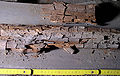
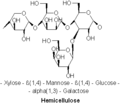
Brown rot fungi break down hemicellulose and cellulose that form the wood structure. Cellulose is broken down by hydrogen peroxide that is produced during the breakdown of hemicellulose. Because of this simultaneous breakdown of cellulose and hemicellulose, the wood shrinks, shows a brown discoloration, and cracks into rectangular pieces, a phenomenon termed cubical fracture.
Soft Rot[edit]
Soft rot fungi secrete cellulase from their hyphae, an enzyme that breaks down cellulose in the wood. This leads to the formation of microscopic cavities inside the wood, and the wood becomes spongy to the touch.
White Rot[edit]
White rot fungi break down the lignin in wood, leaving the lighter-colored cellulose behind. Some white rots break down both lignin and cellulose. White rot may give the wood a bleached appearance and often takes longer to develop than brown rot.
Ecology[edit]
Wood-decay fungi play a very significant role in the carbon cycle. By breaking down the wood they are able to return nutrients back into the soil from where new plants can absorb them. They also use the carbon in the wood as a source of energy, which they then release back into the ecosystem as carbon dioxide.
Economic Impact[edit]
Wood-decay fungi can cause significant damage to wooden structures, furniture, and other items made of wood. They can also be a problem in forests, where they can cause the death of trees. However, they also play an important role in the decomposition of wood in nature, which is beneficial for the recycling of nutrients.
See Also[edit]


This article is a Decomposition-related stub. You can help WikiMD by expanding it!
-
 Wood-decay fungus
 -
 Wood-decay fungus
 -
 Wood-decay fungus
 -
 Wood-decay fungus
 -
 Wood-decay fungus
 -
 Wood-decay fungus
 -
 Wood-decay fungus
 -
 Wood-decay fungus
 -
 Wood-decay fungus
 -
 Wood-decay fungus
 -
 Wood-decay fungus

.jpg)


