Slit lamp: Difference between revisions
CSV import Tags: mobile edit mobile web edit |
CSV import |
||
| Line 26: | Line 26: | ||
{{stub}} | {{stub}} | ||
{{dictionary-stub1}} | {{dictionary-stub1}} | ||
<gallery> | |||
File:Spaltlampe-2.jpg|Slit lamp | |||
File:Retina_Group_slit_lamp_(side_view).jpg|Slit lamp | |||
File:Cataract_in_human_eye.png|Cataract in human eye | |||
File:Diffuse_Illumination.jpg|Diffuse Illumination | |||
File:Focal_illumination.jpg|Focal illumination | |||
File:Retro-illumination.jpg|Retro-illumination | |||
File:Indirect_lateral_illumination.jpg|Indirect lateral illumination | |||
File:Sclerotic_Scatter.jpg|Sclerotic Scatter | |||
File:Slit_lamp_fundoscopy.jpg|Slit lamp fundoscopy | |||
File:Slit_lamp_in_use_in_Koforidua_hospital,_ghana.jpg|Slit lamp in use in Koforidua hospital, Ghana | |||
File:Slit_lamp_in_a_clinic_at_Suhum_Ghana.jpg|Slit lamp in a clinic at Suhum, Ghana | |||
</gallery> | |||
Latest revision as of 12:01, 18 February 2025
Slit lamp is a piece of equipment used primarily by ophthalmologists and optometrists for eye examination. It is an essential tool in the diagnosis of various eye diseases and conditions.
Description[edit]
A slit lamp is a high-intensity light source that can be focused to shine a thin sheet of light into the eye. It is used in conjunction with a biomicroscope. The lamp facilitates an examination of the anterior segment, or frontal structures and posterior segment of the human eye, which includes the eyelid, sclera, conjunctiva, iris, natural crystalline lens, and cornea. The binocular slit-lamp examination provides a stereoscopic magnified view of the eye structures in detail, enabling anatomical diagnoses to be made for a variety of eye conditions.
Uses[edit]
A slit lamp is used for the examination of the anterior and posterior segments of the human eye. It allows the doctor to thoroughly examine the patient's eye for any potential abnormalities or diseases. It is commonly used to detect conditions such as cataracts, macular degeneration, corneal ulcers, diabetic retinopathy, and glaucoma.
Procedure[edit]
During a slit lamp exam, the patient sits in a chair with the instrument placed in front. The patient rests their chin and forehead on a support to keep the head steady. The doctor then shines the slit lamp's light into the eye and examines the eye structures under magnification.
History[edit]
The slit lamp was first developed by Allvar Gullstrand, a Swedish ophthalmologist who won the Nobel Prize in Physiology or Medicine in 1911 for his work on the dioptrics of the eye. The design and functionality of the slit lamp have evolved over the years, with significant advancements in technology enhancing its diagnostic capabilities.
See also[edit]
 | |
|---|---|
 |
 |
-
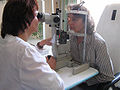 Slit lamp
 -
 Slit lamp
 -
Cataract in human eye
-
Diffuse Illumination
-
Focal illumination
-
Retro-illumination
-
Indirect lateral illumination
-
Sclerotic Scatter
-
Slit lamp fundoscopy
-
Slit lamp in use in Koforidua hospital, Ghana
-
Slit lamp in a clinic at Suhum, Ghana

.jpg)


