Trichome: Difference between revisions
From WikiMD's Medical Encyclopedia
CSV import |
CSV import |
||
| Line 58: | Line 58: | ||
[[Category:Plant anatomy]] | [[Category:Plant anatomy]] | ||
<gallery> | |||
File:Cap1033-botao1.jpg|Trichome | |||
File:Sternhaar_in_Baltischem_Bernstein.jpg|Trichome | |||
File:Drosera_capensis_bend.JPG|Trichome | |||
File:Trichomes_Close_Cannabis.jpg|Trichome | |||
File:Solanum_scabrum_trichomes_on_leaf_lamina.tif|Trichome | |||
File:Solanum_quitoense_petiole_trichomes.tif|Trichome | |||
File:Snapdragon_buds_with_glandular_hairs_--_Antirrhinum_majus.jpg|Trichome | |||
File:Müürlooga_(Arabidopsis_thaliana)_lehekarv_(trihhoom)_311_0804.JPG|Trichome | |||
File:Brachypodium_distachyon_leaf_(x250).jpg|Trichome | |||
File:Red_Trichomes_of_the_roses.jpg|Trichome | |||
</gallery> | |||
Revision as of 11:59, 18 February 2025
Trichome
A trichome is a small hair or other outgrowth from the epidermis of a plant. Trichomes are found on a wide variety of plant species and serve various functions, including protection against herbivory, reduction of water loss, and trapping of insects.
Types of Trichomes
Trichomes can be classified into several types based on their structure and function:
- Glandular trichomes: These trichomes secrete substances such as essential oils, resins, or other compounds. They are often found on plants like Cannabis and Drosera.
- Non-glandular trichomes: These are simple hair-like structures that do not secrete substances. They can be found on plants like Arabidopsis thaliana and Solanum species.
Functions
Trichomes serve multiple functions in plants:
- Protection: Trichomes can deter herbivores by making the plant surface less palatable or more difficult to consume.
- Water conservation: By reducing air flow over the plant surface, trichomes can help reduce water loss through evaporation.
- Light reflection: Some trichomes reflect sunlight, reducing leaf temperature and protecting against UV radiation.
- Insect trapping: In carnivorous plants like Drosera, trichomes can trap insects, which are then digested by the plant.
Examples
- Cannabis: The trichomes on cannabis plants are glandular and produce the plant's psychoactive compounds.
- Drosera capensis: This carnivorous plant uses glandular trichomes to trap and digest insects.
- Solanum quitoense: This plant has non-glandular trichomes that provide a protective barrier.
Related Pages
References
- Wagner, G. J., Wang, E., & Shepherd, R. W. (2004). New approaches for studying and exploiting an old protuberance, the plant trichome. Annals of Botany, 93(1), 3-11.
- Werker, E. (2000). Trichome diversity and development. Advances in Botanical Research, 31, 1-35.
Gallery
-
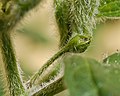 Trichomes on a plant bud
 -
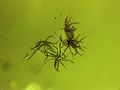 Trichomes preserved in amber
 -
 Glandular trichomes on Drosera capensis
 -
 Close-up of cannabis trichomes
 -
 Trichomes on Solanum scabrum leaf
 -
 Trichomes on Solanum quitoense petiole
 -
 Glandular hairs on snapdragon buds
 -
 Trichomes on Brachypodium distachyon leaf
 -
 Red trichomes on roses


.jpg)

-
Trichome
-
Trichome
-
Trichome
-
Trichome
-
Trichome
-
Trichome
-
Trichome
-
 Trichome
 -
Trichome
-
Trichome
_lehekarv_(trihhoom)_311_0804.JPG)
