Edinburgh: Difference between revisions
CSV import Tags: mobile edit mobile web edit |
CSV import |
||
| Line 44: | Line 44: | ||
{{stub}} | {{stub}} | ||
{{dictionary-stub1}} | {{dictionary-stub1}} | ||
<gallery> | |||
File:Skyline_of_Edinburgh.jpg|Skyline of Edinburgh | |||
File:Scott_Monument_Édimbourg_11_(cropped).jpg|Scott Monument | |||
File:SPCB_-_Public_entrance_at_the_Scottish_Parliament.jpg|Public entrance at the Scottish Parliament | |||
File:Edinburgh_-_Royal_Scottish_Academy_Building_-_20140421192731.jpg|Royal Scottish Academy Building | |||
File:St_Giles'_Cathedral_-_geograph.org.uk_-_5027985.jpg|St Giles' Cathedral | |||
File:Arthur's_Seat_from_Calton_Hill_(cropped).jpg|Arthur's Seat from Calton Hill | |||
File:Surgeons_Hall_-_geograph.org.uk_-_1315862.jpg|Surgeons' Hall | |||
File:Arthurs_seat_edinburgh.jpg|Arthur's Seat | |||
File:Edinburgh_in_the_17thC_(detail)_by_Wenceslas_Hollar_(1670).jpg|Edinburgh in the 17th Century by Wenceslas Hollar | |||
File:The_Parliament_Close_and_Public_Characters_Fifty_Years_Since.jpg|The Parliament Close and Public Characters Fifty Years Since | |||
File:Edinburgh_Castle_from_Grass_Market.jpg|Edinburgh Castle from Grass Market | |||
File:Aerial_View_of_Edinburgh,_by_Alfred_Buckham,_from_about_1920.jpg|Aerial View of Edinburgh by Alfred Buckham | |||
</gallery> | |||
Revision as of 11:56, 18 February 2025
Edinburgh is the capital city of Scotland and one of its 32 council areas. It is located in the southeastern part of the country, on the southern shore of the Firth of Forth. As of the 2021 census, the city has a population of approximately 540,000, making it the second most populous city in Scotland after Glasgow.
History
Edinburgh's history dates back to ancient times, with the earliest known human habitation in the area dating back to 8500 BC. The city's strategic location on a series of hills overlooking the Firth of Forth made it an important center for trade and defense in ancient and medieval times.
Geography
Edinburgh is located in the southeastern part of Scotland, on the southern shore of the Firth of Forth. The city is known for its stunning natural beauty, with a landscape that includes hills, valleys, and bodies of water such as the Water of Leith and the Union Canal.
Economy
Edinburgh's economy is diverse and robust, with key sectors including finance, tourism, education, and the creative industries. The city is home to several major banks and financial services companies, as well as a number of universities and cultural institutions.
Culture
Edinburgh is renowned for its vibrant cultural scene, which includes a wide range of festivals, museums, galleries, and theaters. The city's most famous cultural event is the annual Edinburgh Festival, which attracts artists and audiences from around the world.
Education
Edinburgh is home to several universities and colleges, including the University of Edinburgh, Edinburgh Napier University, and Heriot-Watt University. These institutions offer a wide range of courses and research opportunities, contributing to the city's reputation as a center of learning and innovation.
Transport
Edinburgh is well connected by road, rail, and air. The city's main airport, Edinburgh Airport, is the busiest in Scotland, while Edinburgh Waverley Station is a major hub for train travel.
See also
References
<references />
External links
 | |
|---|---|
 |
 |
-
 Skyline of Edinburgh
 -
 Scott Monument
 -
 Public entrance at the Scottish Parliament
 -
 Royal Scottish Academy Building
 -
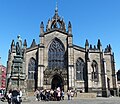 St Giles' Cathedral
 -
 Arthur's Seat from Calton Hill
 -
 Surgeons' Hall
 -
 Arthur's Seat
 -
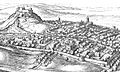 Edinburgh in the 17th Century by Wenceslas Hollar
 -
 The Parliament Close and Public Characters Fifty Years Since
 -
 Edinburgh Castle from Grass Market
 -
Aerial View of Edinburgh by Alfred Buckham

.jpg)


.jpg)


_by_Wenceslas_Hollar_(1670).jpg)


