Earth system governance: Difference between revisions
CSV import |
CSV import |
||
| Line 55: | Line 55: | ||
[[Category:Sustainability]] | [[Category:Sustainability]] | ||
[[Category:Climate change]] | [[Category:Climate change]] | ||
<gallery> | |||
File:Understanding_and_analysing_transformations_towards_sustainability.jpg|Understanding and analysing transformations towards sustainability | |||
File:CC-BY_icon.svg|Earth system governance | |||
File:CC-BY_icon.svg|Earth system governance | |||
File:CC-BY_icon.svg|Earth system governance | |||
File:CC-BY_icon.svg|Earth system governance | |||
File:Frank_Biermann_opening_the_2018_Utrecht_Conference_on_Earth_System_Governance.jpg|Frank Biermann opening the 2018 Utrecht Conference on Earth System Governance | |||
File:CC-BY_icon.svg|Earth system governance | |||
File:CC-BY_icon.svg|Earth system governance | |||
File:CC-BY_icon.svg|Earth system governance | |||
File:CC-BY_icon.svg|Earth system governance | |||
</gallery> | |||
Latest revision as of 11:53, 18 February 2025
Earth System Governance[edit]
Earth System Governance is an interdisciplinary field of study that focuses on the political, economic, and social structures and processes that influence the management and sustainability of the Earth's systems. This field is crucial for understanding how human societies can effectively govern the planet's natural resources and ecosystems in the face of global challenges such as climate change, biodiversity loss, and pollution.
Overview[edit]
The concept of Earth System Governance emerged from the recognition that traditional forms of governance are insufficient to address the complex, interconnected issues facing the global environment. It emphasizes the need for integrated approaches that consider the Earth as a single, interconnected system.
Key Concepts[edit]
Governance[edit]
Governance in this context refers to the frameworks, institutions, and processes that guide decision-making and action regarding the Earth's systems. It involves multiple levels of authority, from local to global, and includes both formal institutions and informal networks.
Earth System[edit]
The Earth System encompasses the planet's physical, chemical, biological, and human components, including the atmosphere, hydrosphere, biosphere, and geosphere. Understanding the interactions among these components is essential for effective governance.
Sustainability[edit]
Sustainability is a core principle of Earth System Governance, aiming to meet the needs of the present without compromising the ability of future generations to meet their own needs. It involves balancing environmental, social, and economic considerations.
Challenges[edit]
Climate Change[edit]
Climate change is one of the most pressing challenges for Earth System Governance. It requires coordinated global efforts to reduce greenhouse gas emissions and adapt to changing climatic conditions.
Biodiversity Loss[edit]
The loss of biodiversity threatens ecosystem services and the resilience of the Earth System. Governance strategies must address habitat destruction, overexploitation, and other drivers of biodiversity loss.
Pollution[edit]
Pollution, including air, water, and soil contamination, poses significant risks to human health and the environment. Effective governance requires policies to reduce pollution sources and mitigate their impacts.
Governance Frameworks[edit]
International Agreements[edit]
International agreements, such as the Paris Agreement and the Convention on Biological Diversity, play a crucial role in Earth System Governance by setting global targets and facilitating cooperation among nations.
Multilevel Governance[edit]
Multilevel governance involves the interaction of governance processes at different scales, from local communities to international organizations. It recognizes the importance of local knowledge and action in addressing global challenges.
Public-Private Partnerships[edit]
Public-private partnerships can leverage the strengths of both sectors to address environmental issues. These collaborations can enhance resource mobilization, innovation, and implementation of sustainable practices.
Research and Education[edit]
Research in Earth System Governance is interdisciplinary, drawing on fields such as political science, environmental science, economics, and sociology. Educational programs aim to equip students with the knowledge and skills needed to address complex environmental challenges.
Conclusion[edit]
Earth System Governance is essential for ensuring a sustainable future for the planet. By integrating diverse perspectives and fostering collaboration across scales and sectors, it seeks to create effective solutions to the global environmental challenges of the 21st century.
References[edit]
- Biermann, F. (2014). Earth System Governance: World Politics in the Anthropocene. MIT Press.
- Young, O. R. (2002). The Institutional Dimensions of Environmental Change: Fit, Interplay, and Scale. MIT Press.
-
 Understanding and analysing transformations towards sustainability
 -
 Earth system governance
 -
Earth system governance
-
Earth system governance
-
Earth system governance
-
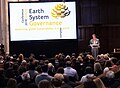 Frank Biermann opening the 2018 Utrecht Conference on Earth System Governance
 -
Earth system governance
-
Earth system governance
-
Earth system governance
-
Earth system governance


